

It was a wet summer. It rained and rained and rained. Too much rain. The field behind our house flourished. Bobolinks nested, and Meadowlarks. Grass grew tall. But we hardly went out there to explore–too soggy. But a couple weeks ago we figured we should head to the back to see if there might be any pumpkins.
When we moved here we discovered a compost pile at the edge of the meadow, next to the woods. It was filled with yard waste and garden trimmings–the stuff you cut back in the spring and fall. We added our own contributions to it. We compost kitchen scraps and some other yard bits in a bin close to the house, but the big stuff we haul across the field to this pile. It is where we toss our Christmas tree when we take it down. The first fall we also discovered pumpkins out there.
The previous owners had left pumpkins in the pile, clearly. They dropped seeds and grew, so our first fall we had a bounty of huge pumpkins, the vines stretching into the tall grass. We found a couple dozen of them, some hidden pretty well. It was like finding orange treasure. We tried to replicate this, adding our own pumpkins, plus squash and other gourds, and overgrown cucumbers and zucchini. We have never had success, but we look each year. On our first visit out there this fall after a wet summer, we found no pumpkins, but we did find something else.
I am always curious about the life that I encounter–plants, animals, insects, fungus. Several years ago a friend turned me on to iNaturalist. When I encounter something in nature I do not recognize, I take out my phone, open the iNaturalist app and snap a photo. Based on the characteristics of your photo, plus your location and time of year, the app makes suggestions for what you have seen, with photos and description. If one of the suggestions you see looks like what you have found, you select it. Then it uploads to a database where others can see it. Others can then look at what you found and agree with your identification or make another suggestion. It has been great to see when I had it right, and helpful to see suggestions that help me get it right.
On this day, across the field filled with ponded water, my spouse and I found a vine growing in the compost pile. I did not recognize the blue berries and the triangle leaves. And the stems had barbs. When we lived in Bolton we would find tearthumb growing in open areas. This low vine with barbs would do some damage to your ankles if you walked through it. This vine seemed similar but was not the same. Was there more than one species of tearthumb? INaturalist told us that it might be one of two species. Neither one looked quite right, but I selected the one that seemed closest and entered it. I figured I would look it up later to learn more.
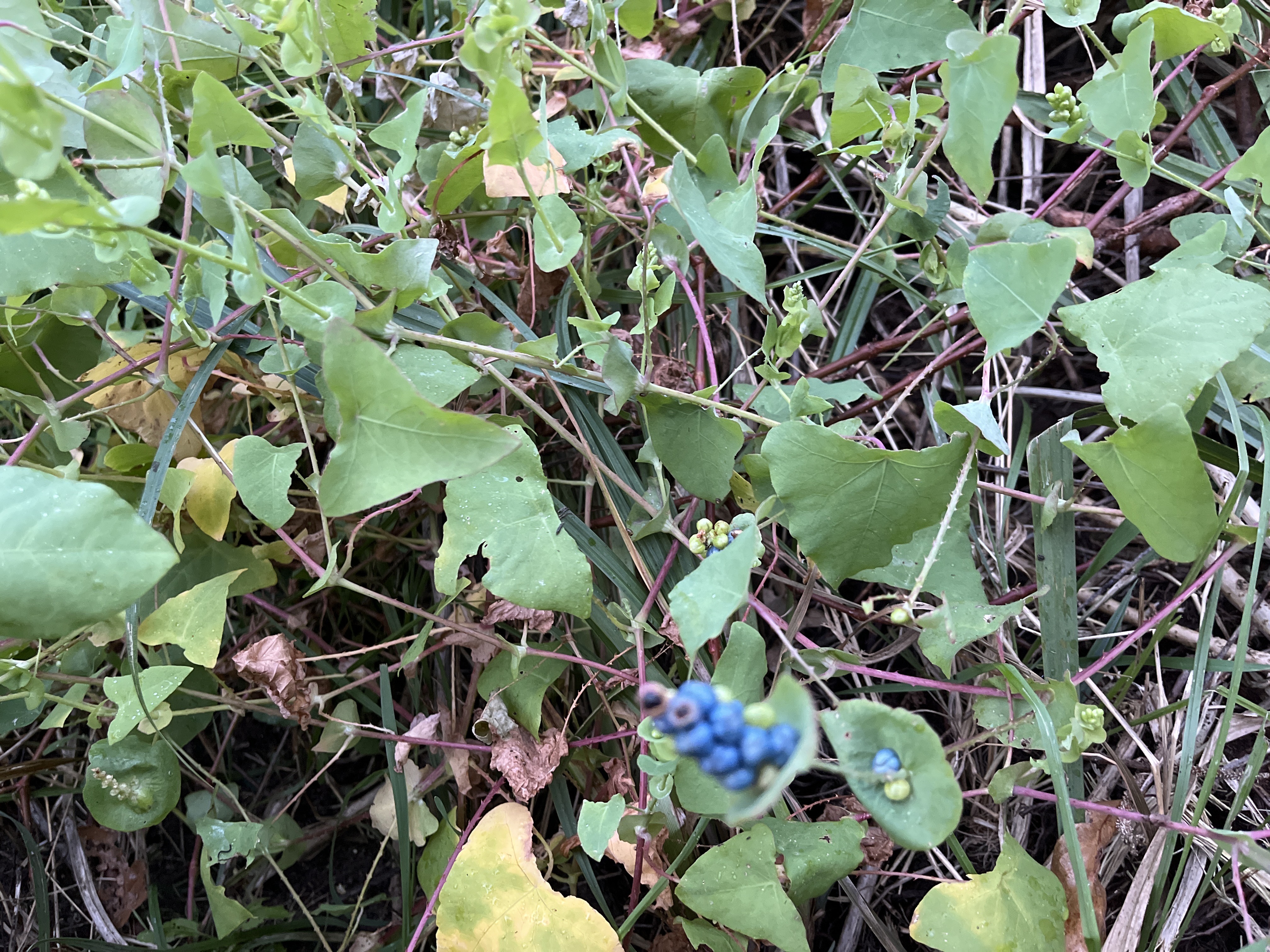
The next day I got a notification for iNaturalist. A retired botanist in Pennsylvania had suggested it was not Halberd-leaved Tearthumb as I had suggested, but Mile-a-Minute Weed. This was not one of the suggestions that came up when I used the app, so now I was really curious. Another Tearthumb? I used the map feature of iNaturalist to find other sightings of this plant in Vermont, but there were none. So I tried Google. Nothing. The Vermont Agency of Natural Resources site let me know that this is a plant of concern but had not yet been found in the state. So I let them know I had found it.
We realized that Mile-a-Minute Weed is invasive and that we needed to pull it, but figured someone might want to see it. The next day I got two calls from people working for the state who did indeed want to see it. That afternoon the two of them, along with my spouse and I, splashed across the field and checked it out. They confirmed it was what it was and we looked around for more. The vine had spread over the compost pile but that was it. Because it grows so densely, we managed to roll it all up, pull the roots out of the ground, and stuff it into a construction-grade trash bag. We scoured for dropped blue seeds, added them to the bag, double-bagged it, and hauled it back. They took it away to destroy safely and that was that.

It was sort of exciting to find the first of a species in Vermont, I admit, but I can’t say it made me happy. Mile-a-Minute weed can really take over and smother everything around it. It has caused problems where it has invaded other places. I took a look a couple days ago to see it there was anything we missed. There wasn’t, that I could see. I will be sure to look again in spring, when seeds might sprout. We could have buried one of those inadvertently. We have had a couple of heavy frosts now, so it is done for the year, but we will monitor the site.
Shout out to iNaturalist for doing the job. Without that tool we would not have identified this invasive plant and it might have spread too much to deal with easily. I am glad we found it, and I am glad it is gone.

 Mercury on the Move