Mowing. Finally. 

One of my favorite sounds of spring and summer is the song of the Meadowlark. That sweet whistling tune makes me smile every time I hear it. This year they nested in our field. Starting a few years ago they were around, nesting in surrounding fields and sharing their songs. Now they nest right here in our meadow. By mid-July, chicks have fledged. We had a half dozen young birds zipping around, buzzing out their calls rather than their songs, done with nests for now.

Other birds were out of their nests as well–Red-Winged Blackbirds, Savannah Sparrows, Bobolinks, Snipes. Birds fledged and Wild Parsnip not yet gone to seed? That means time to cut the field.

I had powered up our tow-behind brush hog in June. I wanted to make sure it started, that the blades spun, that it worked. So when mid-July arrived and the weather cooperated I hooked up the mowing system and got started. Unfortunately, after one pass of one edge of the field, smoke started pouring out of the brush hog. Dang! Busted belt. No more mowing.

There is a repair shop right up the road, so I just kept on going. It was Friday, of course, but they assured me getting parts is pretty quick these days. So I’m thinking they order a belt on Monday, put it on and maybe Wednesday I’m in business, best case scenario. But since I didn’t hear from them I called after a week. They had an estimate for me. Seriously? I’m hoping the thing is ready to go and they haven’t even ordered the belt?

So, giving them the go-ahead, I patiently waited some more. After another week I called again. It was still not done–complications, other parts needed, rust involved. After another couple of calls and another week, it was finally good to go. I picked it up Saturday morning, just before the place closed. It ran like a charm. So I headed out to field, three weeks after I started, Wild Parsnip now starting to go to seed, and started cutting.

I wasn’t sure just how much I could get done that day, but after about eight hours, I had most of it cut. It was a long afternoon/evening. I had planned to stop by 9:00 pm and stopped about ten minutes before that hour. I probably spread a few Wild Parsnip seeds but not too many, I hope. I left a couple of patches uncut but, since we planned to head out for a week the next day, it would have to do.

The birds were definitely cleared out by the time I started cutting. I missed my window between ground-nesters fledging and seeds falling by a bit but hopefully not by too much. If I can get out there and cut once more this fall, the Parsnip should be checked for this season. That stuff is aggressive and I need to keep at it. What I want is for grasses and native wildflowers to grow. I want better habitat for the birds and more food for the pollinators. It has been a long project and may take a good deal more time yet.

In the meantime I can look out over the cut meadow with relief. I don’t see those tall stalks with yellow flowers turning brown with seeds. I don’t hear much birdsong now, but come spring I look forward to the Meadowlarks, flying low across the greening field,  whistling their tunes once again.

Early at Missisquoi NWR

IMG_5350

I like to grind my coffee right before I brew it, but yesterday I made an exception. I did my grinding the night before and set the timer on the coffee maker for 5:05 am. I set the wake-up alarm for 5:00, so by the time I brushed my teeth and got dressed the coffee was ready. With binoculars, camera, bird guide and a full coffee mug, I was out the door.

I headed north to the Missisquoi National Wildlife Refuge. One of my goals this year is to visit five national refuges. I stopped by one in Maine in April. This is number two. I was on the trail by 6:30. Just stepping from the car the birdsong was abundant. Trying to tease out all the various birds’ songs is one of the joys of birding. It is an audio puzzle.

IMG_5354

I was up there for close to three hours. I did not move fast, trying hard to see what birds I could in the rapidly leafing trees. I heard much more than I saw. Eight Northern Waterthrushes? I only got eyes on one. Song Sparrows? I saw a couple. Blackpol Warblers? One out of three sighted. It was lush–green and wet and warming as the morning progressed. It did not feel like my backyard. I was far enough from home that it was familiar, but not quite familiar.

I found many species of birds and got to see some mammals as well. A groundhog crossed the railroad tracks to the trail just as I did. A beaver swam the creek, slapping its tail at me more than once. Sorry, Beaver, just passing through. Squirrels and chipmunks scampered.

The bird of the day had to be the bittern I heard. I did not see it, but they are hard to see anyway. I heard it ga-GLOOMP-ing in the wetland though. Plus those waterthrushes were pretty sweet to find. I had hoped to find a black tern, as they are not common elsewhere in Vermont. I looked, but I ran out of time. I couldn’t spend all day birding, although that would have been fun.

The refuge is a big place. One of these days I will take a kayak up there, or maybe a stand-up paddleboard, and float my way around to find birds. That would be a great way to explore the place. That, however, will have to wait until another visit, perhaps on a day when I can grind my coffee the day I go.

IMG_5353

Fine Spring Day

IMG_6244

Green is coming out. In the yard, daffodils are blooming, white and yellow. Azaleas have popped. Grass is starting to stand up. Spring? I believe so.

I was up early, out to find birds. Otter Creek was flooded. Ducks were scarce at the usual spot by the boat launch. The boat launch was under water. But ducks were abundant in the flooded fields. Shovelers! Ring-Necked Ducks! Plus Mallards and Canada Geese and Wood Ducks. I saw my first Spotted Sandpiper of the year.

Heading home from the ducks I decided to make an extra stop. I walked through Williams Woods. Ruby Crowned Kinglets sang in the brush. Pine Warblers sang in the tops of white pines. A Carolina Wren teakettled far off. And green, trout lilies included, crept across the forest floor.

Clouds gave way to sun but then came back. It is cool but feels warm after those winter days. Rain showers now. I need to get out and pull some early dandelions and grass that is butting in on the flower beds. I might plant some more flowers. The bulbs I planted in the fall are peeking up through the dirt. Soon the world will be a chaos of plants.

Already I think ahead to mowing the field, in July. The meadowlarks are singing, along with Savannah Sparrows. Woodcocks, however, never came back. That is our spring mystery. Where did the Woodcocks go? Or did that final winter storm do them in? Soon we will crank up the lawnmower, and sleep on the porch, and swing in the hammock.

But now we need to enjoy spring–the dawn chorus, the sweet smell of new growth, the wild leeks in the woods. The world feels and smells new.

Wondrous, that’s what it is. Wondrous.

April Rain and Mud

IMG_6206

It rained all day. Roads got muddy. Sky were gray. April. A cold rain. Not the kind to spend the day in. Not a summer rain that ends in sun. At night, after the rain stopped, it froze. Mud got icy.

I walked to the river. It ran high. Water gushed under the bridge and under the extra culverts installed a few years ago. Spring rains would flow over the road. They don’t now. They flood the field on the other side.

The fields all along the river were flooded. Shallow ponds formed. Geese and ducks swam and fed. They avoided the river. It flowed too fast. I tried to see what kind of ducks they were. I saw some mallards. The rest hid behind vegetation.

Despite the rain, song sparrows kept singing. I could not hear them as well as other days. Rain muffled their songs. I had a hood on. My boots sloshed on the road. A phoebe, finally back for spring, tried to sing as well.

When I turned back, rain hit my face. There was not much wind, but I walked into it. I pulled my hood lower. Rain fell harder. I looked down again toward other flooded fields. A kestral perched on a leafless ash tree. Its feathers were soaked. I would say it was not perturbed but it seemed to be waiting. I walked past.

I hung my rain jacket to dry. I listened to rain pelting the roof. The lawn, not yet really awake, oozed. Snow lingers in the shadowed spots. It won’t last long. I picked up a book and disappeared.

IMG_6207

What the Blue Jay Says

IMG_4905

WHAT THE BLUE JAY SAYS


All morning snow—like

nothing but snow—

falling on snow.


The Blue Jay does not compare itself

to the Cardinal.

It sees red.

It sees blue.


It fears nothing—

not silence, not darkness, not even

nothing.


Feathers fallen on new snow

are buried in new snow. Snow

on the Blue Jay, alert

in the sleeping lilac.


Silence, like the water snow becomes,

evaporates into clouds.

In spring it falls between raindrops.

This is the sound of flowers.


The Blue Jay has always known this.

It keeps trying to tell you—

all day shouting and shouting.

Listen, it says. Listen.

Winooski River Portrait 2

Yesterday I volunteered for the second time for the Mid-Winter Eagle Survey. My route was the Winooski River, from Waterbury to Lake Champlain. I stopped at several spots along the river, crisscrossing and paralleling as I went. Unlike last year, this year I did see one Bald Eagle, perched overlooking the mouth of the river. Like last year, I took photos as I went. Here is my January 2017 Winooski River Portrait:

img_4519

River’s edge, Waterbury, Vermont

img_4520

Winooski Street Bridge, Waterbury, Vermont

img_4523

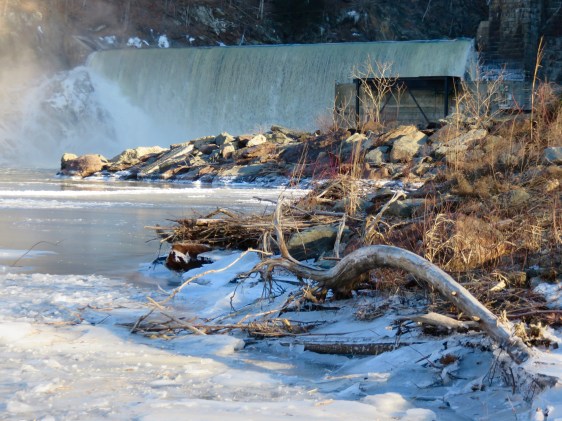
Bolton/Duxbury Dam

img_4526

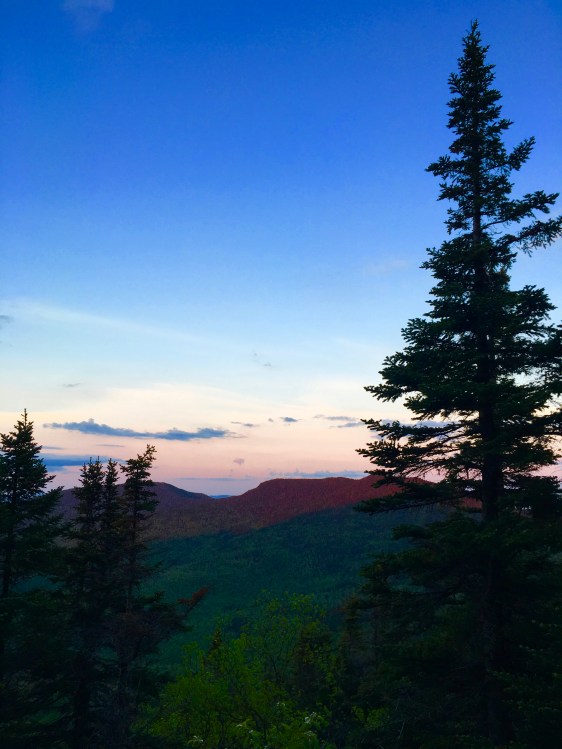
Duxbury, from Long Trail next to Winooski River

img_4528

View of Winooski River from Long Trail Bridge

img_4529

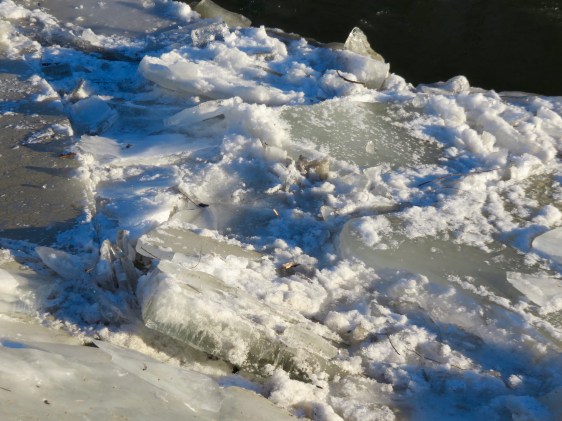
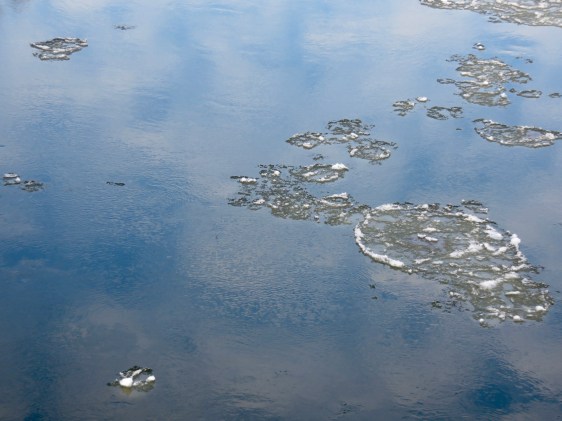
Pancake ice

img_4532

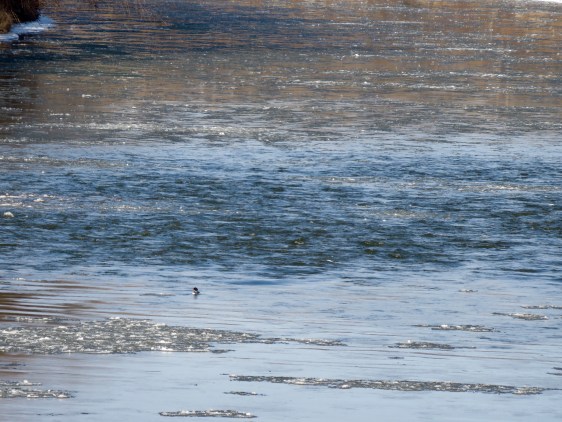
Common Merganser, seen from Jonesville Bridge

img_4533

From Warren and Ruth Beeken Rivershore Preserve

img_4534

Looking west from Volunteers Green in Richmond, Vermont

img_4535

Discarded television, Williston, Vermont

img_4536

View of Winooski River from Woodside Park, Colchester, Vermont

img_4538

Winooski, Vermont

img_4539

Ice at Ethan Allen Homestead, Burlington, Vermont

img_4544

Bald Eagle looking out over Winooski River and Lake Champlain

Messy Eater

img_4440

My daughter romped about in the woods the other day. She got her boots muddy. She left them on the porch overnight. She left them there to dry. She also left them there to avoid cleaning off the mud.

In the morning they looked like this. I just recently hung the bird feeders. I filled a couple of them with sunflower seeds. Someone else did not want to clean up their mess. A squirrel? A chickadee? A mouse? I’m guessing a chickadee was flying back and forth from the feeder to the trellis over these boots. It ate the centers and left the hulls.

I cleaned up after the messy eater. I left the boots for my daughter. I am glad the chickadee wears no boots. I am glad my daughter has some skill with a napkin.

Mountain Birdwatch, Worcester Range, 2016

IMG_3765

Every day this June I have woken and looked around and felt lucky to live in such a beautiful place. I mean, seriously, the place is just full of beauty. You have your green meadows and rolling hills and bare peaks. You have tractors tossing bales and Barn Swallows zooming over soccer fields and rabbits chewing clover. Wonder everywhere.

Again this June I have been fortunate to participate in Mountain Birdwatch, a research program that examines high elevation birds. Earlier this month I drove to Stowe, hiked up to the ridge trail on the Worcester Range and tried to find some of these birds. The hike up whooped my can, as it always does, but it was worth the effort.

This hike shouldn’t be that bad. It is about three miles to get to the start of the survey route. Three miles, how tough can that be? That is a 5K. I ran one of those the other day. But this is a challenging three miles. The first part isn’t bad. I hiked up toward the Stowe Pinnacle. That is a standard hiking trail–steep but well worn, fairly smooth, stone steps in some places. Once I have to veer off from that trail, however, the trail is less forgiving. It is steeper, with fallen trees across the trail, scrambles over rocks. It is not well marked and paying attention matters. No zoning out and just putting one foot in front of the other. It is slippery and rugged–a solid challenge.

The ridge trail is also not much used and can be wet, although this year it was pretty dry. There is only one water source so I have to try to time it right to polish off my water to fill up and treat what I collect. Eventually, after I think several times that I must have passed point one, I finally get there. Now I don’t want to be some wussy complainer, but it is a tiring little walk with a full pack (tent, sleeping bag, food and so on) on a steep trail. Or maybe I am just not in my twenties anymore.

IMG_3766

Painted Trilliums growing right on the trail

As in years past, I scouted the route and counted spruce and fir cones that day, after I set up my tent and left some stuff behind. There were Trilliums and Trout Lilies but there were also black flies. I have not seen black flies like that in years. More than once, as I tried to aim my binoculars at tree tops to carefully count cones (this is part of the survey because red squirrels eat the seeds from cones, and when there are more cones there are more squirrels that survive the winter; since squirrels also raid bird nests for their eggs, the number of cones can be an indicator of bird populations the following year) I said aloud, “I don’t think I can do this!” I was, however, not a quitter. I counted my cones, ate a little something, and crawled into my sleeping bag.

The next morning, rising at 4:00, I had a successful survey. The black flies slept in so I was free to listen and watch and take notes on what I encountered. I found more squirrels up there than ever before but I also heard Bicknell’s Thrush, probably the most important target species, at every survey point. Once I had completed the survey, about four hours later, I took some time to linger. It is beautiful up there, even with limited views, and it smells good. The spruce/fir forest in summer is an olfactory opiate.  It smells like spring after a long winter and Christmas and summer camp and childhood and Life.

I took my time hiking back down. I swatted flies and ran out of water before the stream. I listened for warblers. I soaked in the beauty of the place. Back home, I took a nap. Then I sat on the porch and looked out over the fields. The grass rolled in waves in the wind. Kingbirds snatched insects from the air. Wonder everywhere.

Sugaring Weather

IMG_3560

Frosty. That was this morning. Grass, branches, porch railing, stones–all frost-covered. The air was still. I rose before the sun crested the mountains, walked into the morning. The ground was frozen, so walking was easy and quiet. I wore a down jacket.

Despite the cold, a few degrees below freezing, the blackbirds sang. Song Sparrows tried their best to stake out their territories. Over a hundred geese flew overhead. Yesterday’s puddles sported white caps of ice.

In the river, a beaver broke the water’s surface, swimming around the bend. A mink bounded along the shore, pausing to watch me as I watched it. The river babbled its usual course under the bridge.

When the sun appeared, it spread light across the fields, melting the frost. In the shadows, ice held on. Soon enough, those crystals would droop and disappear. The puddles would be free. Bluebirds would sing as the breeze arose.

Freezing nights and warm days. That is just what sugar makers need. There will be some boiling today. I hope to take my empty gallon jugs up the road to Shelburne Sugarworks today to get them filled. They say they will have sugar on snow, but I’m not sure there is snow to be had. Maple cotton candy, perhaps. My guess is they will be boiling today. The weather is just right.

Morning Dancing and Ice Left Over

IMG_2203

As the day lightened I stood on the edge of the field, listening. A Northern Cardinal called, then another. A Song Sparrow sang, just once. Two geese flew overhead, honking quietly, as if they needed to talk but did not want to wake anyone. I did not hear the woodcock again.

My wife had woken me to tell me she heard a woodcock, then tossed open the window and we heard it together. It bleated its noisy song, then rose in circles and dropped back to the field, its feathers whistling as it fell. Rain dripped off the off. I went outside to try to hear it again, but by the time I stood there listening, its dance was over.

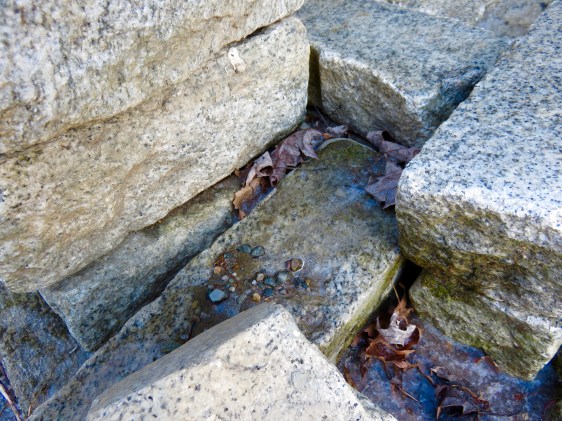
The morning was warm enough to leave hat, gloves, boots in the mudroom. It smelled like spring–the earth thawing, grass stirring, mud, last fall’s rotting leaves. Ice, however, lingers in the shadows. On the north side of the house a triangle of ice nestles the compost bin. The compost–hard to stir as feathers of ice burst from its crumbling body. Between stones, ice frames pebbles. Below trees, logs of ice under logs of wood.

As I watched the morning, wind blew across the brown. The rain stopped, waiting for afternoon to start again. Robins chattered and crows cawed. But I did not hear the woodcock again. The warm day melted some of the hidden ice. When the sun set, rain again fell from the roof. Dampness seeped under the door. In the morning, perhaps, the woodcock will dance again. I will rise in the dim light, again, to listen.