Mowing and Meadowlarks

IMG_4554

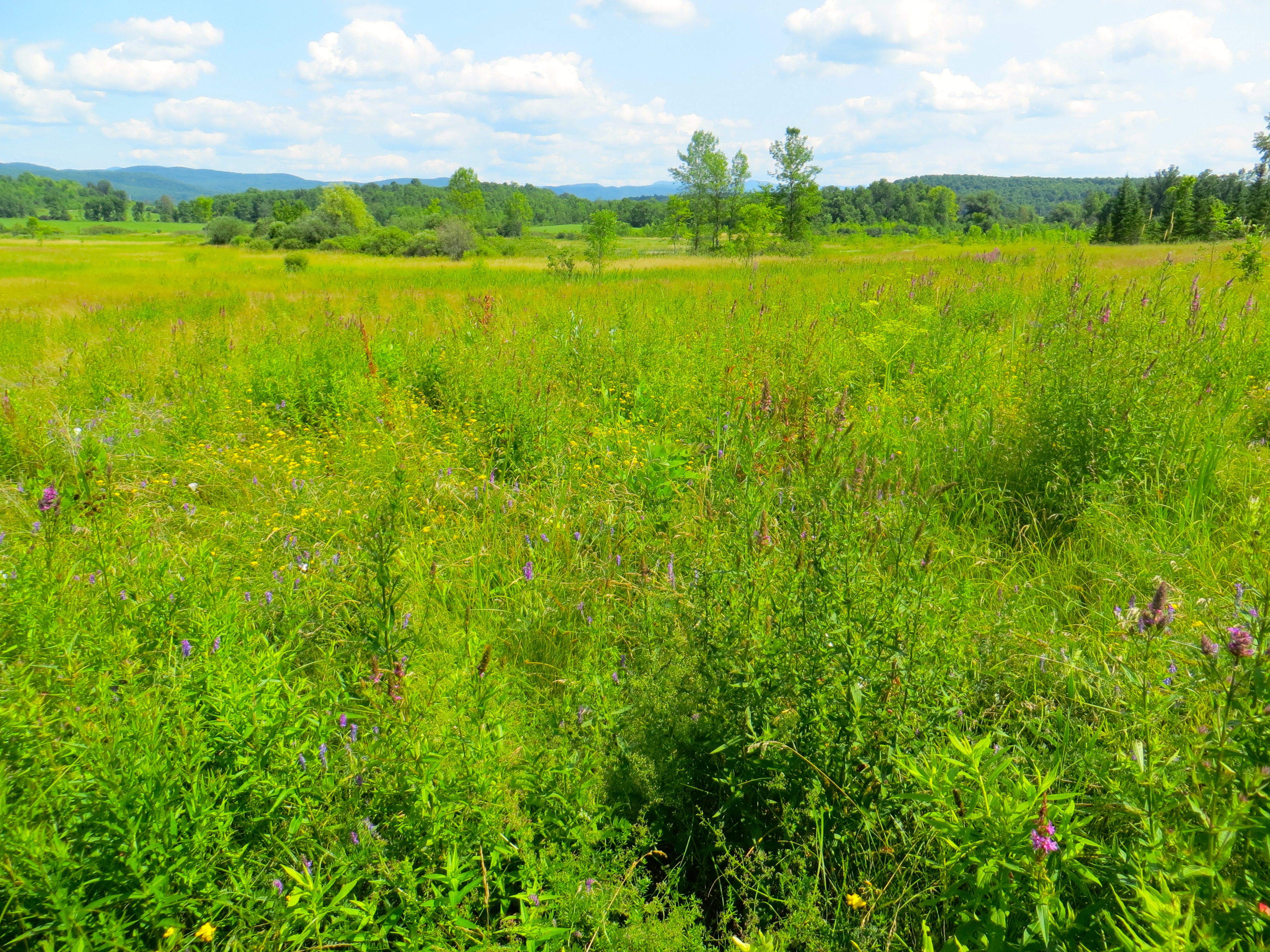
This is the time of year when we get around to mowing our field. We have ten acres of meadow. When we moved here it had not been cut in several years and it was starting to get scrubby. Cattails grew in a wide swath. Ash trees were sprouting and willows were standing out among the grasses and wildflowers. Actually, the grasses were pretty limited. The field had long passed the point of being suitable for haying. We wanted to turn that around.

One reason we wanted to turn it around was Bobolinks. There were Bobolinks nearby, in adjacent fields and up the road, but none in our field. It was just too overgrown. They like to nest in grasslands and our meadow was quickly reverting to woodland. We borrowed a tractor with a brush hog and cut it, cattails and all. We did the same thing the next year. We were not, however, especially deliberate about it. We cut it when we had access to a tractor and it worked. Grasses started to grow and it looked good.

I have learned a bit about this small habitat of ours since those early years. First, we have three invasive plants (more I am sure but three major ones): wild parsnip, purple loosestrife and reed canary grass. The purple loosestrife was the worst at first and those early cuttings really made a difference. We still have it but it hardly dominates like it did. It has beautiful flowers which get visited by butterflies and hummingbirds, so it is hard to hate it, but I would rather it did not take over.

The reed canary grass I started learning about recently, even though it was pointed out a few years ago. It, too, is a beautiful plant, which is why it and purple loosestrife are both used as ornamentals. It grows in thick mats and apparently can be hard to eradicate. This grass isn’t too bad yet–we have a few patches but it has not taken over.

The real villain is the wild parsnip. When we first encountered this plant we thought it might be wild dill. It is tall with yellow large-headed flowers. I looked it up and learned that the roots are edible, hence the name. It is, however, not a pleasant smelling herb or a ready food source. It is a menace.

There are fields where wild parsnip has simply taken over. The plants can get to be super tall–eight feet sometimes–and they will push out native plants. I have seen fields where it is the only plant visible. If those fields eventually grow up into woods the wild parsnip will disappear, but in sunny fields it is a bully. Moreover, the plant is toxic. The oil from the plant can rub off and, when exposed to sunlight, can cause chemical burns. Photoreactive is the word. In short, we wanted to make sure it does not live in our field.

The solution would be to simply cut the field several times a year to keep invasive plants from growing and to let native grasses grow up. So simple. The problem is that birds nest on the ground. Bobolinks have started to nest in our field since we started cutting. Also nesting on the ground: Red-Winged Blackbirds, Savannah Sparrows and, most recently, Eastern Meadowlarks. The biggest enemy of these birds is the mower, so cutting when the birds are nesting is bad juju.

Now we try to be deliberate about when we mow. The trick is to wait long enough for chicks to have fledged but to get to it before the wild parsnip has gone to seed. That would be right about now. Pretty much. Red-Winged Blackbirds and Bobolinks are hardly around at this point, so I am not worried about them. The Meadowlarks, however, are still chattering away and flying all over. They may be on egg clutch number two, and there are at least two pairs.

This year the compromise was clear–cut the front part of the field where the parsnip is the worst and leave the back part of the field, where the birds are nesting, to be cut in a couple of weeks. Yesterday, after mechanical issues that finally got solved, I got on that. It was like scratching an itch. Mowing down those wild parsnip plants, several of which were taller than me, felt good. I was relieved that, unlike last year when I cut it, none of it had gone to seed yet. Phew.

IMG_4557

Brush hog doing its work

There is still more of the field to cut, of course, and wild parsnip is in there. Hopefully, however, because so much of it is newer growth, it won’t be too bad. I may look to do a second cutting in October or November. That would help with the canary grass, and the birds will be heading south by then. I thought I might do that last year and never got to it, however, so I’m making no promises.

As I write this Meadowlarks are calling and Savannah Sparrows are singing. Leaving the most grassy part of the field for now is clearly the right choice, but I will look forward to seeing those yellow wild parsnip heads get shredded when I finish the job.

Upper field cut

Upper field cut with a couple of small trees left for birds to perch

Mowing Complete

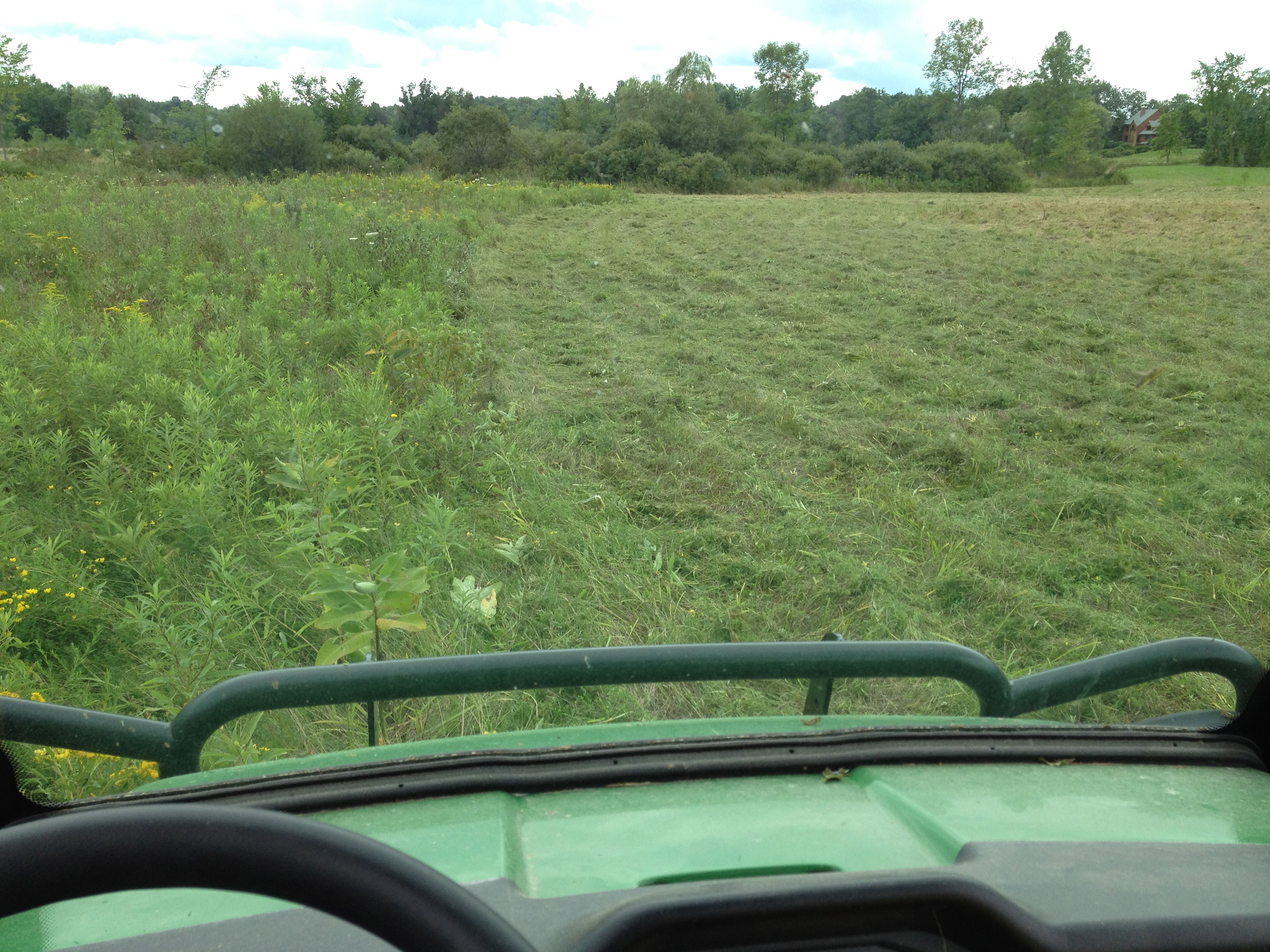
Tall stuff on the left, flattened on the right

I finally finished mowing our field today. We have a new set-up to make this happen–a John Deere Gator and a DR tow-behind brush hog. It worked remarkably well. Once we had all the parts and added oil and gas and started things up, I hit the field and got cutting. But I was stymied more than once.

In the past we have postponed our mowing due to the weather. The field was too wet or it rained when we had the time to cut. Or we didn’t have a tractor with a brush hog when we needed it. We were hoping this would take care of at least the latter issue. And it did, sort of. I started near the end of July. This was perfect. We needed to wait until at least mid-July so that any birds nesting in the field would have fledged. Bobolinks and red-winged blackbirds are ground nesters and we wanted to make sure they didn’t get chopped up in the blades. That is just bad juju. Also, part of the reason we are cutting all this vegetation is the wild parsnip–the stuff has taken over and we wanted to cut it down before it went to seed. That started off well.

Then I had a problem. I got stuck in reverse. I couldn’t get it into drive again. I shook the rig and wiggled everything around and eventually it went into gear. But then it happened again. So we called the dealer and they hauled it away to be fixed. Then, of course, we went away for a week. Two weeks after I started mowing I recommenced. I made some progress but much of the wild parsnip had gone to seed. I needed to get it done. And then, unbelievably, it got stuck in reverse again. Same problem–not fixed after a new shift cable was installed. They took it back and were not happy about it, but fixed it again–bent stick shift this time. They were patient, as were we, and soon the machine was back. Today I got back in the saddle and everything went smoothly. I finished mowing just in time to zip out to pick up my daughter from day camp.

The wild parsnip had almost totally gone to seed–it was brown and dry and sometimes the seeds scattered as I hit the plants. Not good. But those seeds would have scattered at some point anyway. I needed to cut it now and then cut it again later. The key to keeping this stuff down will be (hopefully) to just cut it again and again until it has nothing left to keep growing. It could take a while–maybe years. The good news, however, is that I also was cutting purple loosestrife, another invasive that has been super aggressive in our field. That had not yet gone to seed, so it should be less work to keep that back.

I may cut one more time this fall. That could mean we get more grass than other, more woody, plants come spring. That is good for the bobolinks. They don’t nest in our field much because it has less grass than surrounding fields. Maybe the birds will take a liking to our space and settle down to raise some chicks next year. If I don’t get to it, so be it. I at least will cut again next July and keep those invasives at bay. Unless I have trouble shifting again. But I will worry about that if it happens. For now I can be satisfied that one summer project is finally complete.


Purple Loosestrife

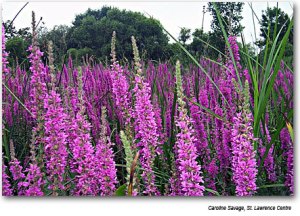
Purple Loosestrife (Caroline Savage, Saint Lawrence Centre)

Purple Loosestrife (Caroline Savage, Saint Lawrence Centre)

I noticed it two years ago.  The showy purple flowers, standing tall like spears amongst the cattails.  I knew what it was and thought, “I should get rid of that stuff.”  I pulled some of it, in the ditch next to the road, but the plants deep in the wet part of the field I just left.  Next year I would get it.

By this year it was well established.  It has really spread from the few plants I saw two years ago.  A few weeks ago I pulled some of it.  I tried to get all of it at one end of the field, where there were only a few plants.  I dug up a few more in the broad field and along the road.  Then I put it off.  That stuff is hard to pull out of the ground.  I got out there today and had some work to do.

Purple Loosestrife was brought to North America in the 19th century as a source for medicines and through ship balast.  It was further introduced when it was brought to gardens as a perennial flower.  Canals and roads helped it spread.  It is beautiful.  The flowers are tall and colorful and shine in the sun.  But it is also trouble.  The plant likes wet areas and can take over, outcompeting native plants and clogging the place right up.  It spreads underground, roots sprouting new stalks, and it also produces zillions of tiny seeds.  I had to take action.

Let me say right off that I did not get the job done.  I pulled some up by the roots, prying with a fork, but most of it I just clipped with pruning shears.  I would have preferred to yank it out but there is too much at this point.  I needed to at least get the flowers out so they don’t go to seed.  I clipped and dragged and pulled and piled for a while.  I got cut up and sweaty and tired and had three huge piles of stalks.  When I looked back, I could see that it at least was contained a little more.  I had kept it from spreading, a little.  If I can get out there again this week, the field will be better off.  If I can at least cut it all, I will have a head start next summer.

There is no way it is going away any time soon.  Even if I were to dig up all of it, it would likely come back sooner or later.  It is tenacious and voracious.  And we have a great spot for it.  I may be pulling it for as long as we live here.  Apparently one can use herbicides to control it.  I say no thanks to that.  And there are some insects that might snack on it, but I hesitate to take that route. One invasive species is enough.  If I can scale the plant back every year, there is a chance I might get rid of it eventually.  It will take some time, however, and a lot of work.  For our field to stay healthy, however, it needs to be done.  And ain’t nobody else taking on that task.