Scrapping Paper

Here is what I can’t figure out: why does my bank allow me to make electronic payments for free? I have all my account information with them and I can just log on, enter amount for the account I want to pay, and BOOM, done.  I don’t have to write checks and payments both get there and get processed sooner.  It saves me time, saves me money, and is way easier and faster.  I just made two payments this afternoon. It took me all of two minutes.

OK, I do get why they make it free. It saves them time and money as well. I worked at an organization that processed payments and we encouraged people to take advantage of electronic billing and payments.  Handling a paper bill and a paper check once it arrived too way more time and effort than having it enter the system on its own. Still, I keep waiting for the catch. Heck, we used to pay the day care center electronically through the bank. Since the center did not accept electronic payments, the bank mailed a check. I guess that worked better for the bank. It certainly worked better for me.

I do get a few statements in the mail still. The bill for one credit card we hardly use comes in the mail, for example. And I still make charitable contributions mostly by paper check. I buy many fewer checks these days. I am always surprised when I run out. I order those online.

In fact, I get most things by ordering online–clothes, Christmas gifts, bandages, seeds, flavored syrups, books, music, whatever. A while back I subscribed to a service called YourMusic, which sent CD’s once each month for 7 bucks each. Add CD’s to your queue and they get sent automatically. It is a good deal, except I had to get those CD’s in the mail. Now I just use iTunes. I rarely read a paper newspaper, either. I read it online.

I have been reading The Guernsey Literary and Potato Peal Pie Society. It consists of a collection of letters. I am fully engaged in the story. I want to be reading it right now, in fact. I have not yet given up paper books altogether (although I have enjoyed a few on my iPod Touch). I have realized by reading this book, however, that I never write letters anymore. I used to write scads of them. It used to be the thing to do when I was in my teens and twenties. Now text messaging has become the norm. Letters, however, have a tangible and emotional substance to them. They can be held. They last. I have stopped writing them, as have most people in the 21st century. This has its convenience and certainly saves resources. We do miss something by giving them up, however.

I don’t feel that way about bills. Send me an email notice and let me look it up through the magic of the internet. I get far more unsolicited crap in the mail these days than anything of use or worth. Thanks for your good work, I want to tell all these organizations looking for donations. I would love to help but I give to others and you don’t make the cut, so stop sending me mail. I tell them that often–I either send an email or just stuff the contents back in the return envelope with a note. Still, I’d rather they did not send me something I did not ask to receive. They would save a lot of money by not mailing me all that junk. They should talk to my bank.

I have plenty of paper files hanging in file folders, but I am trying to cut down. Do I really need those bank statements from the past seven years? I doubt it. Tax returns I’ll save, although it is unlikely I will need those either. One of my summer projects is to clean out the closet. I will pull out the recycling bin and drop it next to the closet and transfer contents from one to the other. And when I  am done I will leave the dust on my journal and get online right here to tell about that exciting adventure. As if that is a good idea.

Up There Early

I have to complete my surveys for the Vermont Center for Ecostudies‘s Mountain Birdwatch program in the first three weeks of June. Today is June 15 and I hadn’t gotten out there yet. The days when I could have done it we had rain. Birds don’t sing much in the rain, and I wouldn’t hear them anyway, so today I finally got one in. I had to work today but I’m down to one week left, so I didn’t want to take any chances that the weather would turn again. It will rain more soon and I have two surveys to do.

The survey consists of observing for five key species of birds at high elevations in the northeast. The route I did today is the one I have done for 11 years now, since the first year of the program.  The deal is to observe them between 4:00 AM and 6:00 AM as they tend to be most active during this “dawn chorus” time. That means getting to the first of my five survey points by 4:00, which means hiking by 3:15 if I hoof it, which means hitting the road to the trailhead by 2:30, which means getting up at 2:15, assuming I have everything ready the night before, which I did.

I made it up there in time and sat in the dark for about 15 minutes before any birds sang. I heard a White-throated Sparrow first, as I typically do. I also recorded Swainson’s Thrush, Blackpol Warbler and Winter Wren. The most important species, Bicknell’s Thrush, was silent. I got to the end of my muddy and wet one-mile route, sat at the last survey point, and got nothin’. This is terribly disappointing, of course. Hearing that they are still up there gives me hope. So I went to Plan B.

Plan B is to offer an audio playback of Bicknell’s Thrush calls and songs, in hopes of attracting them, to see if they really are out there. This did the trick. A little brown thrush did come in at the first point I tried the playback, but I couldn’t tell for sure that it was a Bicknell’s, so I tried again. This time I heard the distinctive buzzy call and, to borrow from Wordsworth, my heart leapt up. Satisfied, with some data that will hopefully be enough for now, I headed back down. It was 6:15 and the sun was up.

I hiked past Bolton Valley Resort to get to the survey route and got to see the wind turbine they put up in the last year for a new angle. I got some first had experience with how a large turbine sounds. It did make some noise. Not so much that it would be a nuisance in a city with lots of noise anyway, but some. It was good to see it up there, presumably creating electricity while its blades spun.

So I was successful. I am now tired. When I do this thing on a weekend, I take a nap at some point. I’ll have to head to bed early tonight. Hopefully my children will do the same.

Muddy Trail

Morning Fog in Waterbury

Bolton Valley Wind Turbine

Turbine Up Close

Florida Pretty Much Screwed

Lego Tourists: The Only Ones in Florida Soon?

Florida is pretty much screwed. The Gulf coast is going to be covered in oil. All those hundreds of thousands of barrels of oil spilling into the Gulf since April 20 are going to start sifting onto the sandy beaches before long. It is only a matter of time. I was on that coast in March and it was lovely. We have planned to return, to visit family again, this fall. Maybe so. Maybe not.

I once took a charter boat out to fish off the reefs in the keys. It was a good time. We caught barracuda, among other fish. I can’t imagine that industry will not be hit. All those condominiums and hotels won’t be full. All those flights to Sarasota will have spare seats. Those beaches will have plenty of space to spread a blanket.

The New York Times reports today that tourism is already taking a hit, with reservations at a serious low for sport fishing and other pursuits. The article quotes a fisherman who see the Florida keys “emptying out like an abandoned mining town.” Oil towns have booms and busts, such as is happening in North Dakota right now. Florida may have its own bust cycle due to oil–not because the state decided to allow drilling but despite it. The state could be slammed and not rebound for decades.

Granted, Louisiana and other Gulf coast states are getting hit harder by this disaster, but Louisiana chose to drill for oil. Florida chose not to. The whole situation is insane. If we have to seek oil a mile below the surface of the ocean, doesn’t that say something about our addiction? I am as complicit as the next United States citizen, so I am part of the problem, yes. I am lucky not to live where this will affect me so directly. It will, I am sure, effect all of us in ways we cannot anticipate, however.

Eventually, unless we face up to our addiction, we might all be screwed.

Snapper

Laying Eggs

This snapping turtle was laying eggs a few days ago. Good for you, turtle. Procreate! I’m all for those cute little buggers popping out of the sand and wiggling their way toward a new life trying to avoid things like raccoons and crows, who only want to eat them for breakfast.  This turtle, however, was depositing its potential offspring right on the side of the road.  Cars are whizzing by and its just hanging out there, popping out unformed youngsters.

Honestly, I’m not sure why turtles have been around for millions of years, or why they live to be, like, 100. Granted, we have pretty much destroyed any hope of any other creatures, aside from the ones we eat, surviving at all on this mess of a planet, but come on, turtle, how about my driveway at least? Those speeding high schoolers won’t slow down for you if they don’t slow down for the rain soaked muddy turn. That most humans don’t live to be 100 makes sense to me.

I’ll have to watch out for those little guys in however long it takes for snapping turtle eggs to hatch. I’ll even move them to safer locales, too, as long as it isn’t when school gets out.

Canadian Smoke

Last night we slept out in our tent next to the house. As we had the previous two nights as well. Apparently, this has become a tradition of sorts. This makes three years in a row for that activity on Memorial Day weekend. I woke with a sore back to the smell of smoke. The smell was faint at first, but got stronger. It was not worrisome. It smelled like a neighbor had a fire lit to ward off the morning’s chill. The temperature hovered around 50 degrees last night.

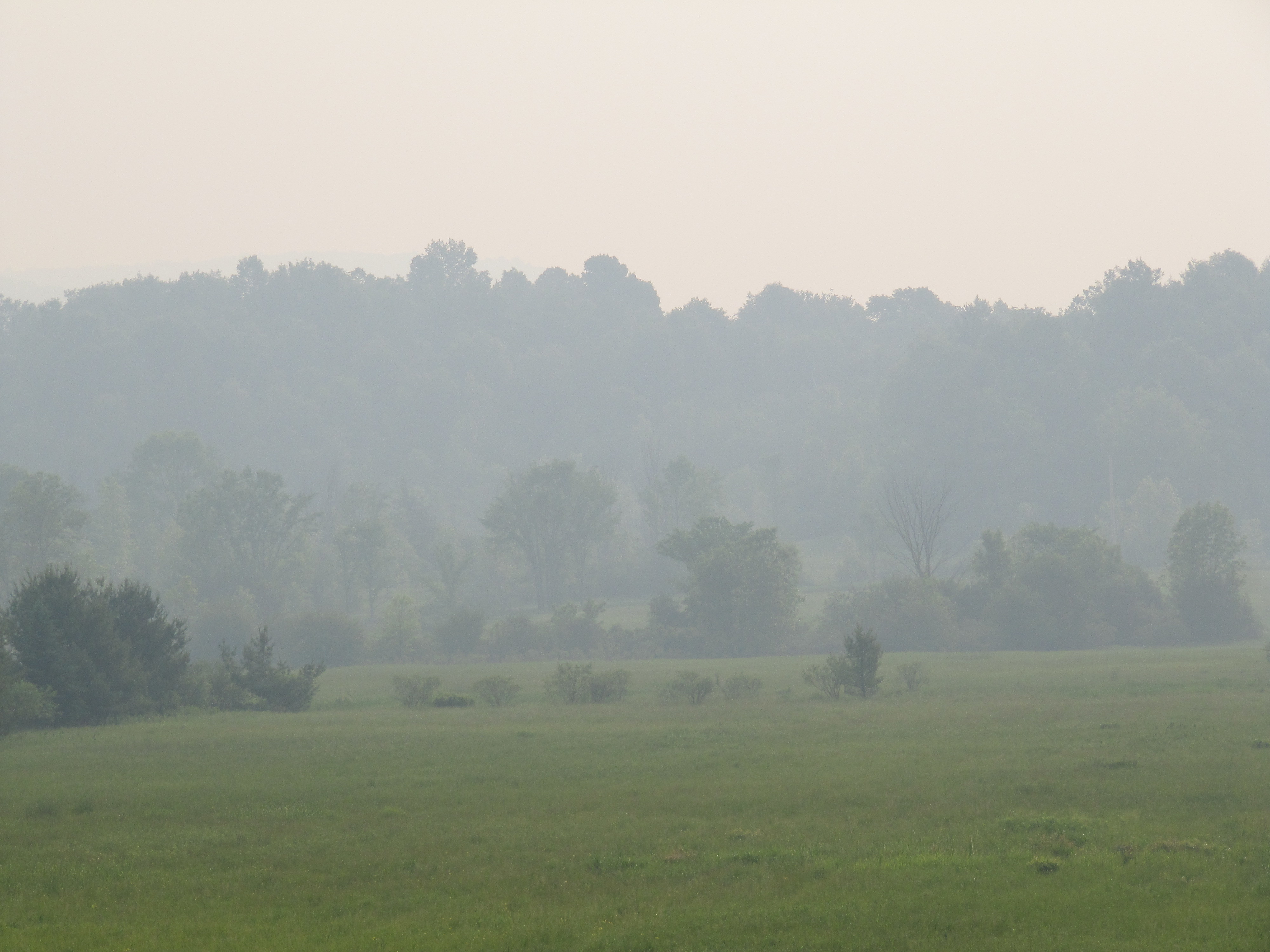
It turns out there are a series of forest fires in Quebec. The northern wind has been blowing the smoke our way. It seemed misty this morning but the sun should have long since burned off that business. What lingers is smoke:

No View Today

Not Fog

We’ve got some poor air quality for this Memorial Day. The wind is forecast to shift later today, so things should clear at some point. Maybe in time for the parade in Vergennes late this morning. In the meantime, no panting allowed.

Paperless

I have made the switch, for the most part. When I pay bills, I don’t write many checks. I still pay my mortgage with a paper check, but that is the last one I’ve got. Electric bill, insurance, phone bill, they all get sent electronically. I was paying some bills tonight and I couldn’t figure out why I got a paper insurance bill, in the mail, when I also got an email. This has been happening for a while and I have checked my account a few times to make sure I signed up the right way. I did. Tonight I figured it out.

Our insurance bill is primarily in my spouse’s name, although we both are, of course, responsible for paying it. So she needs to change her account to request electronic statements. All I had to do was look at the bill. Duh. We’ll get that switched up right quick.

It is pretty liberating to simply not get so much mail. So much of it just gets tossed. I save statements out of some sense of obligation. But who goes back and looks at old insurance bills or bank statements? Maybe if I owned a business or something I would, but even so, my first instinct would be to look at my online account. I do look at my electric bills on line, to compare them and see how we are doing with our current usage. I don’t save those bills. I am not planning to save much anymore. Paper paper paper. It clutters the closets. I don’t need it.

I also try to cut down on catalogs. When we get one I know we don’t want I send them an email telling them not to “sell or rent” my name and to remove me from the mailing list. I don’t want mail from them and I also don’t want mail from the people to whom they want to sell my contact information. Enough already. I pretty much hate to get catalogs that get dumped right into the recycling bin. Junk, that’s what it is. If I want your catalog I will ask for it thank you very much.

So less paper is what I am after. I am hoping that cutting down on all the mail will mean fewer visits to the transfer station. That would be a plus. I could spend less time there, and less money. Paperless is for me.

Eating Around Here

I made dinner tonight and let me tell you it was good stuff.  It was simple, really, but a simple pleasure.  I scrambled up eggs and cheese and we ate it with greens. The greens were as simple as the eggs–leeks, garlic, peppers and kale with some salt and butter.  The combination was tasty, tastier than I thought it would be.  It felt good to eat food so wholesome and healthy.  And it felt good to know that almost everything came from right around here.

The leeks and kale came from our farm share. Our last pick up was Tuesday and we got a lot. We used some of it tonight. The peppers came from our garden–the last of them to be picked. The butter was Cabot butter, so also fairly local. The cheese in the eggs was also Cabot, and the eggs came from Maple Meadow Farm in Salisbury (the eggs could be more local, I admit, but this wasn’t bad). The olive oil traveled far to get to us, as did the salt, but those are hard to get from local sources.

The one thing that was questionable was garlic. That came from a farm somewhere, but that’s all I know. Our farm share did not include garlic several times in a row–they didn’t have a great year. I missed the farmer’s market last Saturday–I couldn’t get there until too late. And our local market, which often has good local produce, didn’t have any local garlic, so I bought what was there, even though I hate not to know the source of my food. Part of the reason we had no garlic was that the garlic I bought at the farmer’s market a couple weeks ago I planted in the ground. I want to make sure I have plenty next year, so I planted all the cloves and hope for them to burst out of the ground in spring. That would make things local, eh?

So our meal had only a few food miles. It is simply crazy that our food system means we can get cheap food that is transported hundreds or thousands or miles. How is it that we can spend 87 calories to get one calorie and not pay more for that one calorie than we do? How is it that we are OK with the poor quality of those strawberries or winter tomatoes when we buy them, out of season? We ship food all over the place so we can eat whatever we want whenever we want it. So we get poor quality food and we burn up all kinds of oil to get it and we pump CO2 into the atmosphere like mad (literally) when we could could have better food at less real cost if we ate locally. So I try to do that.

Having a garden helps. Taking part in a community supported agriculture program helps. Living in Vermont helps, as local food is available much of the year because people care about it. And canning and freezing helps, too, as that means we can spread the harvest out over the cold months. I am new to canning but thanks to my parents giving me a tutorial, I have canned my second batch of jam. I have pesto and pumpkin and soup in the freezer and will freeze more. I could do better and, with some experience and over time, I will. Pulling pesto out of the freezer in January is just about the best thing ever.

Keeping my food miles down is important. I don’t want my food traveling more in a year than I do. It is one thing I, and collectively we, can do to make a difference to abate global warming. Eating locally can make a big difference in limiting carbon emissions, since we all need to eat. One day we will be forced to eat more locally, since oil will get expensive and raspberries from temperate climes won’t be cheap to ship in the winter. Plus, food usually tastes better if it hasn’t traveled half way around the world. And it has more in it, so it is healthier. Sure, if we eat locally we don’t get to have anything we want whenever we want it, but waiting for things makes them sweeter, sometimes literally. And I can wait for a little sweetness.

(This post is part of Blog Action Day).

Soda Maker

I have been wanting to purchase a counter top carbonation machine for a while.  These jobbers take tap water and add carbonation.  Voila!  Seltzer made at home.  You can also add whatever flavoring you want to make soda or spritzer or what have you.  Problem:  they require a big investment.  OK, we’re not talking solar panels, which are even better an idea but cost what some might literally call a fortune, but still, these babies are pricey.

How pricey?  Well, I have pretty much decided that Sodastream is the brand to get.  The entry level model cost a hundred clams.  That gets you what you need to get started, including the replaceable carbonating cartridges.  Once you use up the carbonation you can send them back and get more (for a fee, of course).  The top of the line model cost twice that for the basic package.  Of course, you can also buy extra bottles, extra carbonators, flavor mixes, what have you.  They make four models of increasing sleekness, although they all do pretty much the same thing.  The one I want, of course, is the top of the line model.  I would be happy to settle for a “lesser” one but that one contains less plastic and uses glass (instead of BPA free plastic) bottles.  Go figure.

I placed a few bids on the classy one on eBay but the bids went too high.  Not worth it.  Then I found a mid-range model on eBay and bid on that, but got outbid.  It is hard to find a bargain on these things apparently.  I will get one at some point.  I have some cash set aside from my birthday and other events.  I’d rather spend less if I can.  Duh.  The thing is, it pays off in the long run.  We got through spurts of drinking seltzer but that gets expensive and there are lots of plastic bottles.  Not only do the bottles get created in the first place but I have to deal with recycling, and that chore is a big fat hassle.  I’d like to leave that one behind.  And save money.  They estimate a liter of seltzer costs about 20 cents with this thing.  I guess that depends on how you factor in the original purchase price but still, it will save money.

And we will drink more seltzer and other fizzy drinks if we have one of these on the counter.  I love to drink the bubbly stuff, but I often don’t, either because we are out or because I can’t bring myself to buy any more.  This would alleviate both of those issues.  A carbonating cartridge makes about 60 liters so if we had a couple of those we could make a lot.  And we could have soda parties, just for fun.  We could make tonic water for summer beverages.  We could go places with this thing, be popular, make a name for ourselves.

Or we could just enjoy some fizzy drinks.  Either way.  I just need to get the best price I can and make the plunge.  Soon.  Soon.

What Am I Doing?

This summer I read an article in Orion Magazine that has really stuck with me.  It was Forget Shorter Showers by Derrick Jensen.  Here is an excerpt:

An Inconvenient Truth helped raise consciousness about global warming. But did you notice that all of the solutions presented had to do with personal consumption—changing light bulbs, inflating tires, driving half as much—and had nothing to do with shifting power away from corporations, or stopping the growth economy that is destroying the planet? Even if every person in the United States did everything the movie suggested, U.S. carbon emissions would fall by only 22 percent. Scientific consensus is that emissions must be reduced by at least 75 percent worldwide.

He goes on to talk about water (more than 90% is used by industry and agriculture), energy (individual consumption is 25% or less) and waste (municipal waste accounts for only 3% of the total).  The message that I took away was not that what we do doesn’t make a difference.  It does, and we need to do it.  But if we want to make the kind of change required to address climate change, then tackling it by recycling and carpooling won’t cut it.  We need change on a bigger scale.

The basis of our economy, of any capitalist economy, is that we need to grow and grow, endlessly.  A business is seen as a failure if it fails to grow.  Making a profit isn’t good enough.  We ask that businesses make more profit every month/quarter/year.  The GDP needs to grow, employment needs to grow, sales need to grow, new home starts need to grow.  We can never have enough.  That is the problem.  I love to get a raise, but when I’m told I can’t have one this year I make do.  My home doesn’t need to get bigger every year.  I don’t need to gain weight.  In many spheres of our lives, we know that growing is not always good–it comes with a price that often we don’t want to pay.

So why is it that we need to keep growing, in the big picture, in our economy?  The idea is so ubiquitous that it isn’t even questioned.  We hear regular reports on the news about “the economy,” as if any of us really know what that is.  The “economy” isn’t growing so things must be bad.  No, people are out of work, so things are bad.  People are out of work because we constantly depend on growth.  When growth turns into shrinkage, people lose jobs.  We don’t work with a sustainable model where our economy is flexible enough to accommodate fluctuation.  Or at least our values aren’t there.

We need to deal with climate change, but with a mindset that we need to keep growing, it is difficult to talk about shrinking carbon emissions.  I keep hearing talk of the search for some technological silver bullet that will allow us to keep up the same habits and yield lower carbon emissions.  It’s not going to happen.  We need to make major changes to how we think about our economy, agriculture, transportation, everything.  Changing light bulbs isn’t enough.  Changing systems is what we need.

This morning I heard the mayor of Pittsburgh, Luke Ravenstahl, noting how the city has been trying to change its image from dirty and industrial to “green.”  The very next sentence in the story noted that the city has this huge supply of bottled water ready for those coming to Pittsburgh for the G-20 summit.  Excuse me?  You just said you are going for a green image and you are offering bottled water for a summit where world poverty, which commonly involves issues of access to fresh water, will be a major topic of discussion?  Um, bottled water has too many issues to list.  Am I the only one to see the irony here?

After seeing the film The Age of Stupid the other night (moving and powerful and a must see for anyone who isn’t a climate change denier), and continuing to ponder Jensen’s article, I have been thinking about what the heck I might do.  I have made personal change.  That is necessary both to send a message to others that one is serious and to actually make a bit, however small, of difference.  I have changed light bulbs and I use the clothesline whenever I do the laundry.  I try to limit waste.  I compost.  I grow some of the food we eat.  I also, however, have been writing to my congressional representatives.  I at least need to do that.  If I want us to make big changes, I have to let some of the people in a position to make those changes know what I think.

What else might I do?  I am not all that sure.  That is one of the problems here.  We all need to stand up, to get involved, to cry for something bigger than tax incentives for solar panels we can’t afford even with incentives.  We need to get out there and take action now.  Climate change is a problem that won’t wait for us.  I’ll start by writing.  I will write on October 15 about climate change for Blog Action Day.  You should, too, if you have your own blog.  And I’ll talk to people.  I need to do more and I will figure out my place in the solution to this problem as I go.  I’m getting started.  We all need to.

Purple Loosestrife

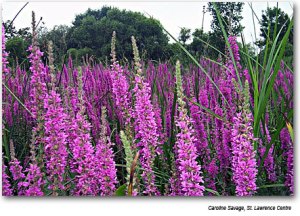
Purple Loosestrife (Caroline Savage, Saint Lawrence Centre)

Purple Loosestrife (Caroline Savage, Saint Lawrence Centre)

I noticed it two years ago.  The showy purple flowers, standing tall like spears amongst the cattails.  I knew what it was and thought, “I should get rid of that stuff.”  I pulled some of it, in the ditch next to the road, but the plants deep in the wet part of the field I just left.  Next year I would get it.

By this year it was well established.  It has really spread from the few plants I saw two years ago.  A few weeks ago I pulled some of it.  I tried to get all of it at one end of the field, where there were only a few plants.  I dug up a few more in the broad field and along the road.  Then I put it off.  That stuff is hard to pull out of the ground.  I got out there today and had some work to do.

Purple Loosestrife was brought to North America in the 19th century as a source for medicines and through ship balast.  It was further introduced when it was brought to gardens as a perennial flower.  Canals and roads helped it spread.  It is beautiful.  The flowers are tall and colorful and shine in the sun.  But it is also trouble.  The plant likes wet areas and can take over, outcompeting native plants and clogging the place right up.  It spreads underground, roots sprouting new stalks, and it also produces zillions of tiny seeds.  I had to take action.

Let me say right off that I did not get the job done.  I pulled some up by the roots, prying with a fork, but most of it I just clipped with pruning shears.  I would have preferred to yank it out but there is too much at this point.  I needed to at least get the flowers out so they don’t go to seed.  I clipped and dragged and pulled and piled for a while.  I got cut up and sweaty and tired and had three huge piles of stalks.  When I looked back, I could see that it at least was contained a little more.  I had kept it from spreading, a little.  If I can get out there again this week, the field will be better off.  If I can at least cut it all, I will have a head start next summer.

There is no way it is going away any time soon.  Even if I were to dig up all of it, it would likely come back sooner or later.  It is tenacious and voracious.  And we have a great spot for it.  I may be pulling it for as long as we live here.  Apparently one can use herbicides to control it.  I say no thanks to that.  And there are some insects that might snack on it, but I hesitate to take that route. One invasive species is enough.  If I can scale the plant back every year, there is a chance I might get rid of it eventually.  It will take some time, however, and a lot of work.  For our field to stay healthy, however, it needs to be done.  And ain’t nobody else taking on that task.