Waste of time

A friend of mine used to keep these regular lists. He listed all kinds of things about his life. It was a helpful reflection for him and, often, a source of interest or amusement for those of us who saw them. He gave it up a while ago, but yesterday sent one to a group of us and I have been thinking about for hours. I was doing some especially productive pondering while I was shaving in the shower this morning (side note: I flippin’ love shaving in the shower and I highly recommend that those of you who shave give it a go). This was the list he sent. I take no credit for it and I did edit it a bit for clarity.

List of Things I did to Waste Time While in College, listed In no particular order, and excluding drinking, etc..

  1. Wall Ball, I think was the name, soccer on a squash/racket ball court, with misses leading to being placed against the front wall and shot at from point blank range.
  2. How many plates can you eat, at dinner, times through the line in the dining hall.  Only do-able when you are 20, and playing a serious number of sports.
  3. Some incredibly stupid game when we threw a tennis ball at a semi-enclosed light on the ceiling in the dorm lounge.
  4. Flipping through college’s actual, print and paper, face book, making decisions about who was attractive, pre-Facebook.
  5. Watching Magnum PI reruns after dinner, think every night we did this. Note: there were all of 3 stations on our dorm TV.
  6. Saturday college football, Sunday NFL football.
  7. A handful of incredibly stupid video games, including an early version of Tetris.
  8. Hang out in the “spa,” with an order of nachos, and semi-pretending to study.
  9. Go downtown to either make a late-night run to Dunkin’ Donuts, or to buy CDs.
  10. This one was not my thing, but I had friends who tried to memorize MLB box scores, and then would quiz each other on them.
  11. Play name that tune, which involved going to someone’s room and having the DJ put in random CDs from their collection, play for like 3 seconds, see who could guess the band and the song.
  12. Stay up for days on end, then sleep for extended periods of time.

I admit I participated in some of these things, although not all of them. I did not play Wall Ball as I was not a soccer player and it would have meant simply getting pummeled by a high speed soccer ball. It feels a bit odd to reflect on judging people’s appearance in the paper face book but I did participate in that common practice. I would like to think we all have grown out of such behavior by this point but I can only speak for myself.

What struck me the most about this list, however, is the title. All of these are listed as a waste of time. But are they?

I recently listened to a Radiolab podcast called The Secret to a Long Life. It suggested that novelty can help us stretch time, that by doing new things, or by doing the same things in different ways, we can experience them with an extended sense of time. The extreme extent of this would mean that if you could do novel things constantly your life would seem to last forever. I felt pretty good after listening to this since I am regularly trying to do things differently. I try to take a different route home from the office. I put on my right sock first, instead of my left. I whisk the pudding with my left hand. These are all small things, but they demand that I pay attention more.

If you have ever experienced any kind of accident–car crash, falling off a ladder, getting hit hard in a sports game–you may have experienced time slowing down. Time does not actually slow down, but because we are experiencing something new/exciting/traumatic/dangerous our minds pay attention to more details than they do during other experiences. When you drive the same route every day you may find yourself miles down the road and realize that you hardly noticed the place you have been passing through. But when your car slides off the road or hits another car, your mind registers all the details of the event–you notice more and the time is more full.

The key here (and the lesson of the podcast) is that time will seem slower, our lives will seem longer really, when we experience things where we pay attention, whether that is by our own design or it is thrust upon us. The things that stand out for me in my long life are the things that were new, or different, or unexpected, good and bad. I remember the very first time I kissed my wife, but the hundredth time? I am afraid I do not. I can remember being transported in an ambulance, and standing on top of Black Mountain alone for the sunrise, but what I had for lunch on October 1st? Um, nope.

To me, the things that make life worth living, the things that make life full, the things that teach us the most powerful lessons, the things where we feel the most, the things that make this human life a thing at all, are all of those things we experience in detail, those experiences where we pay attention. We work to make a living so, I hope, we can have a life. Life lies in our attention.

So, the list. Most of the things on this are things that require paying attention. OK, maybe not watching football so much, or sleeping for extended periods, but most of these things are memorable because they were not mundane. They were novel. And having experiences like that is the point. To live a good life, to live a life worth living, requires that we do things like the things on this list.

I am not going to go out and try to get a Wall Ball league started, but I am going to get up early and go for a run in the dark with the wind blowing snow in my face while I sing a song from Lemonade Mouth. I am not going to memorize box scores but maybe I will go see an MLB game in a city I have never visited. And I should try black pepper on vanilla ice cream–I hear that is amazing.

Thank you, my friend, for posting this list. It helped me to remember some of the joys of my earlier days, and it got me mulling over about how to live a joyful life. Heck, all that thinking and even writing this are things I just may remember in future years. After I get some work done (that making a living thing actually matters, people), I need to find me some Tetris to play.

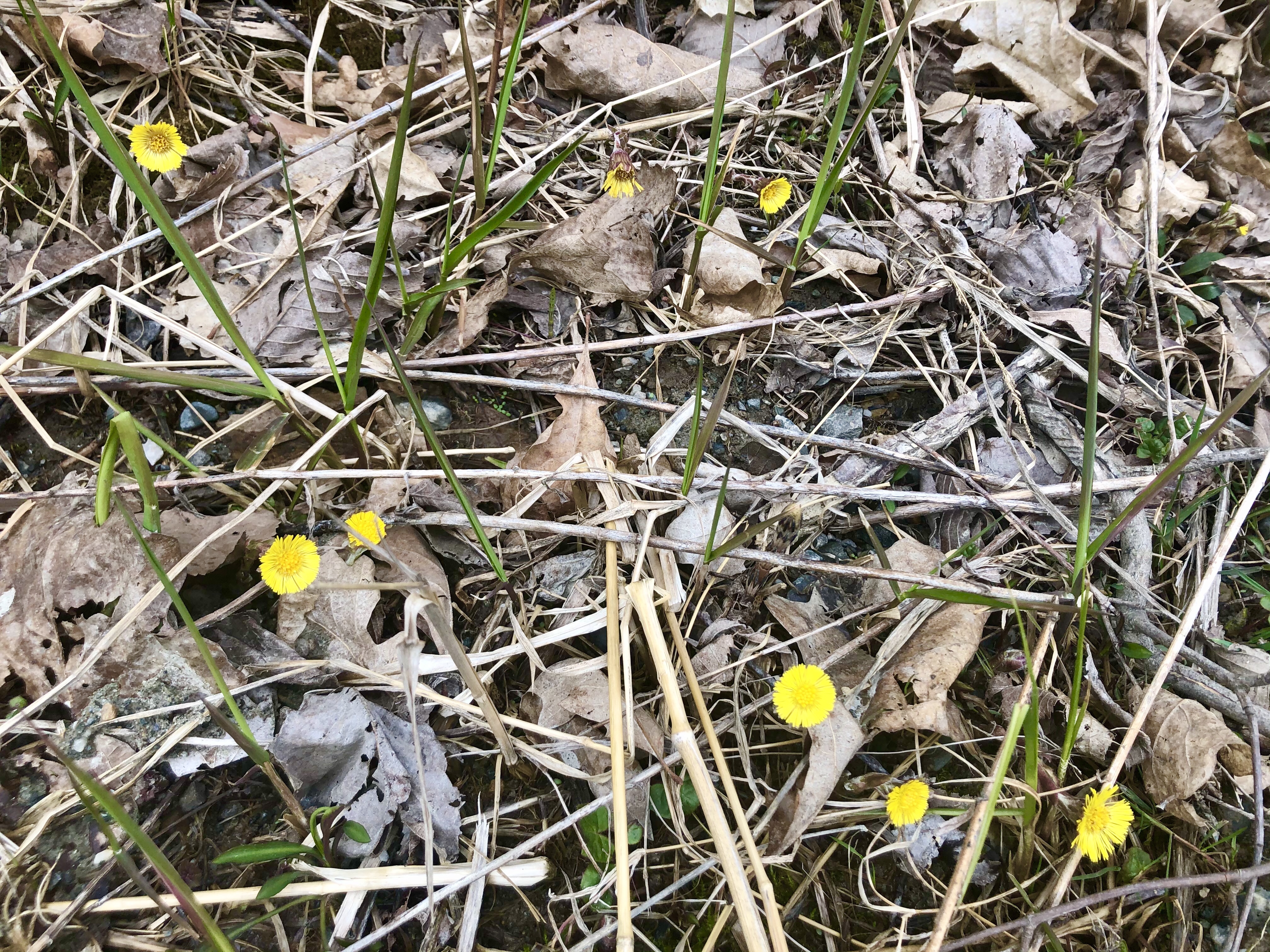
Colt’s Foot and Wild Leeks

There have been a few crocuses popping up but I’m not sure they count. The first flowers of spring are really Colt’s Foot. They pop out of the leaf litter on the roadside, yellow stars among last year’s crumpled leaves.

In the woods now, wild leeks emerge. There is a place nearby where I can see down and down into the trees as they slope downward to the west. This time of year it is clear of undergrowth. The floor of the forest grows green with wild leeks as they pierce the matted vegetation. Like crocuses they come from waking bulbs.

I will find my way into the woods behind our house, bend down and dig. I will pull some wild leeks from the soil and turn them into soup. I will bake bread and serve them with the soup. We will taste spring in our house.

Today, as the sun rose, the river smelled like more than melted snow. It smelled like earth and rain and new grass. I stood where the river flows under the road. Colt’s Foot bloomed at my feet. A Meadowlark sang, then zipped across the road until it disappeared into the willows.

Are we more attuned to spring this year? Do we notice more now that we have all slowed down? We are afraid, some of us, of what might come. Some of us are afraid of what has come. Spring, however, also comes. The yellow flowers bloom. The green leaves push up from bulbs.

I imagine the Phoebe, broadcasting from the roof of the falling barn, sings about such things. Perhaps, however, I give the Phoebe too much credit. I find beauty in the life that has been hidden, while the Phoebe simply finds insects and carries leaf stems to build its nest. It sings of that.

It is not wrong for me to be afraid. It is not wrong to admire life seeping back all around me. The Snipe, circling ghost-like over the meadow at dusk, reminds me that I can be both, reminds me that the turning of the world is worth my attention, whether I am afraid or not.

Why Pay Attention

I remember reading once that the best newspapers are ones that feature people.  They name names.  They contain photographs of those in the community.  The stories are about readers’ neighbors and friends and family.  People buy the paper because it has direct relevance to them.  Recently we have been receiving in the mail, unsolicited, a section of the Burlington Free Press that is about people in the community.  It contains stories about everyday people and it contains lots of photos.  Normally, I pitch those free papers, but I flip through this one every time.

I check it out because I may see someone I know in those photos.  I have seen people I know in its pages.  I was in it once, as were my children.  USA Today won’t contain pictures of anyone I know personally.  This little paper likely will.  So I open it up each time and peruse it before adding it to the pile of fire-starting material.

I thought of this little newspaper today.  This past weekend I spent some time with David Grant, who is president of the Geraldine R. Dodge Foundation.  He just announced he is leaving his position.  He wrote about this on the foundation’s blog.  I subscribe to the blog through a reader.  The foundation hosts a huge poetry festival every couple of years.  It is of interest to me.  I had not made the connection, however, between David’s association with the foundation, and my own interest in it.

I find that I sometimes do this somewhat dramatically, at least in my own head–I connect two things together in one arena and then connect one of those things with something else in another arena;  and then one day a light bulb goes off that all those things are related.  I have a Eureka moment–“Hey that is related to that, and that is related that and whoa, everything is connected!”  The reason this seems so dramatic to me is that I spend a lot of my mental energy on looking for and finding connections.  Discovering how things intertwine brings me real joy. So when I find that I have missed something that, in hindsight, seems so obvious, I stumble a bit.

I had one of those moments this weekend.  “Oh, David directs that Dodge Foundation–Duh!” I thought to myself.  Today I went back and looked at the foundation’s blog and found the articles that David had written that I had previously just skimmed over.  I hadn’t noticed who had written them and so had not made a personal connection to them.  This time I read them more thoroughly.  They were interesting to me the first time, but they were more interesting to me with another read.  I had some context the second time around.  I could picture who was doing the writing and I had at least some idea of how he thinks, of what he has experienced in the world.  It made the articles more relevant.  I had a picture.

The point is, I paid more attention because I knew the author of the article.  I suppose, while the writing is of a very different type, I might compare it to a favorite poet or author.  If I have enjoyed a poet or author I am likely to pay attention if he or she comes out with a new book.  I have some context, some personal history, so I have a link to the new book.  That is what happened with David’s blog posts.  That is what happens with the local newspaper that comes in the mail.  Once I feel that I have a connection, or that I might have a connection, I pay more attention.

I think most of us do this.  The captain of the U.S. ship that was recently hijacked by pirates and then released, was from Vermont.  Vermonters paid attention.  My guess is they paid a lot more attention than Oregonians or Floridians.  They had a connection, even if it was not directly personal.  It was still personal.  We pay more attention when a neighbor is in trouble than when a stranger is.

This is why it is important for me to look closely.  When I look closely I notice more, and the more I notice the more I am likely to see connections.  Then I pay more attention.  Attention feeds attention in a positive feedback loop.  The more I pay attention, the more connections I see, and so the more I pay attention.  If all of us could stop to look closely, to ask questions, to challenge our assumptions, to simply wonder, we would see that many things are not so strange after all.  We would see that we are connected to our world.  And we would notice what we do.  And we would see how we affect those around us.  And we would better understand that all we do has consequences, good and bad.  And we would, perhaps, make more conscious and better choices.

Maybe not, but I’ve been doing my best to pay attention to what I see in the people I encounter everywhere I happen to be.  I believe if we could slow down and refect a little more, we might just take care of ourselves and our neighbors and our world better.  And that would certainly be something to which we all could pay attention.