Spiders in the Morning

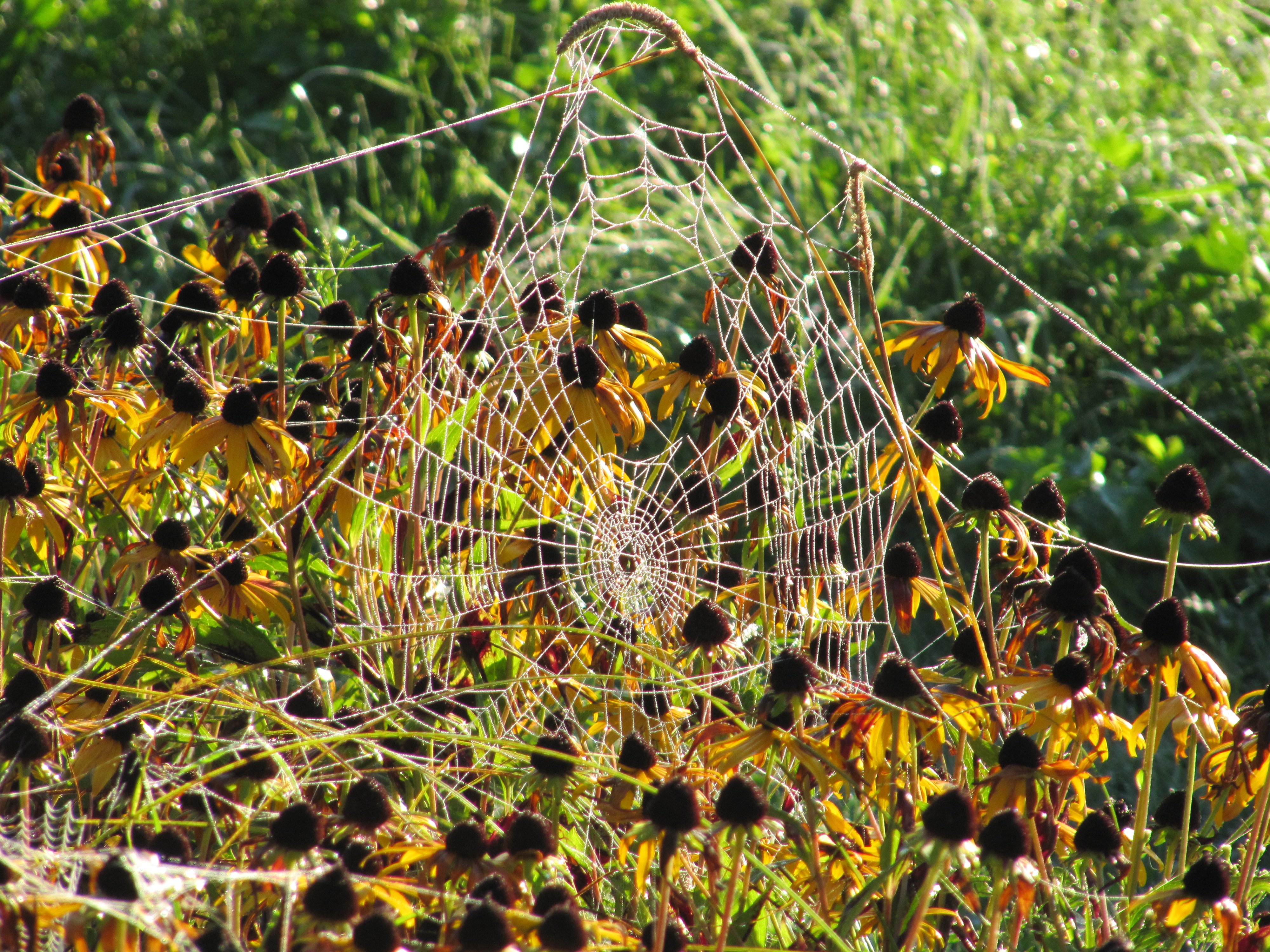
In the morning these days, the sun catches the light across the field. The nights are cool, and that means dew on the leaves. The milkweed and grasses and goldenrod are covered in beads of water.  And if you look when the sun is shining at just the right angle, you see the spider webs. The light only lasts a short time and then they disappear, but if you catch it right you can see them everywhere.

There are hundreds of them, stretched between stalks, glowing in the morning light, their creators waiting for things to dry so they can have breakfast caught the night before, or so they can repair the damage and try again. There are too many to count.

Gazillions of Webs

I have been looking at them up close and took a few photos. Some are whole and some are broken. Each is amazing, a geometric wonder, woven by tiny creatures we usually don’t even see.

This One Liked the Black-Eyed Susans

More Perfection

This One Took Some Hard Knocks

And I found an orb weaver. This one has been settled in the flowers for weeks. They like to hang in one place for a while. Check out the zig zag below her. And check out how cool this spider looks. Kind of a combination of “don’t mess with me” and “don’t like I look beautiful?” all in one.

Queen of Her Realm

Fine Summer Day

Perfect Summerness

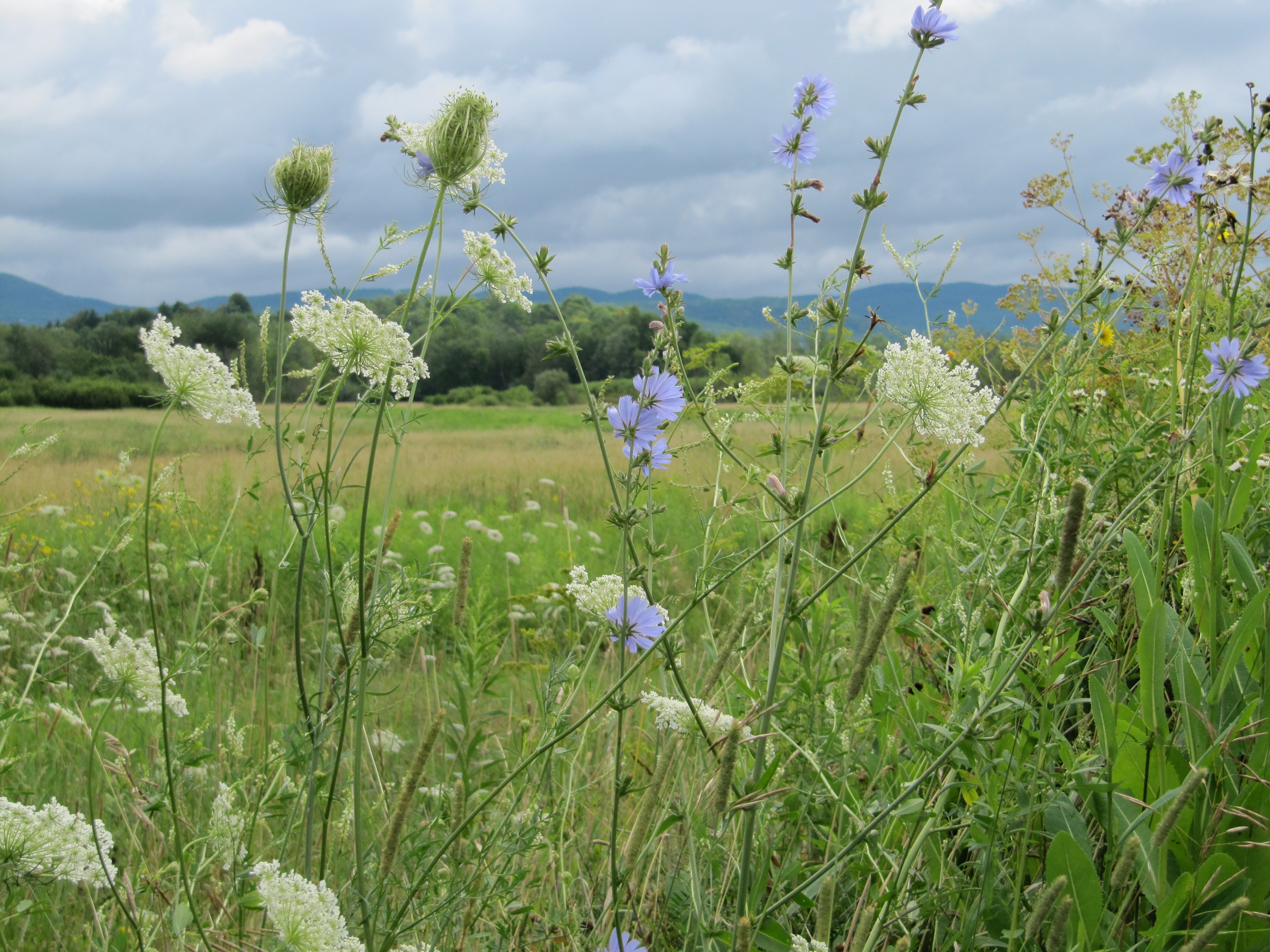
We had some friends visiting these past couple of days and we got out and enjoyed them, both the friends and the days. This morning included a bike ride nearby and I was struck by the beauty of the clouds, the wildflowers, and the mountains in the high contrast light. The wind blew, bending the tall stems in the field. Smells of earth and flowers wafted about about. The river flowed cloudy with yesterday’s rain. We sat and, well, just sat for a while, before heading back home.

Queen Anne's Lace and Chicory

Late in the day, our friends headed home, I finally stained the deck. It took longer than I anticipated, as it always does, but I am glad to have that done. Now I just hope the rain holds off long enough for it to dry. I really should have 24 hours for it to dry, but I guess this will have to do. We are forecast to get rain showers by early afternoon. Maybe they will hold off until at least late afternoon. The forecast seems to change every day. It must be summer.

Field of Flowers

More Wild Parsnip

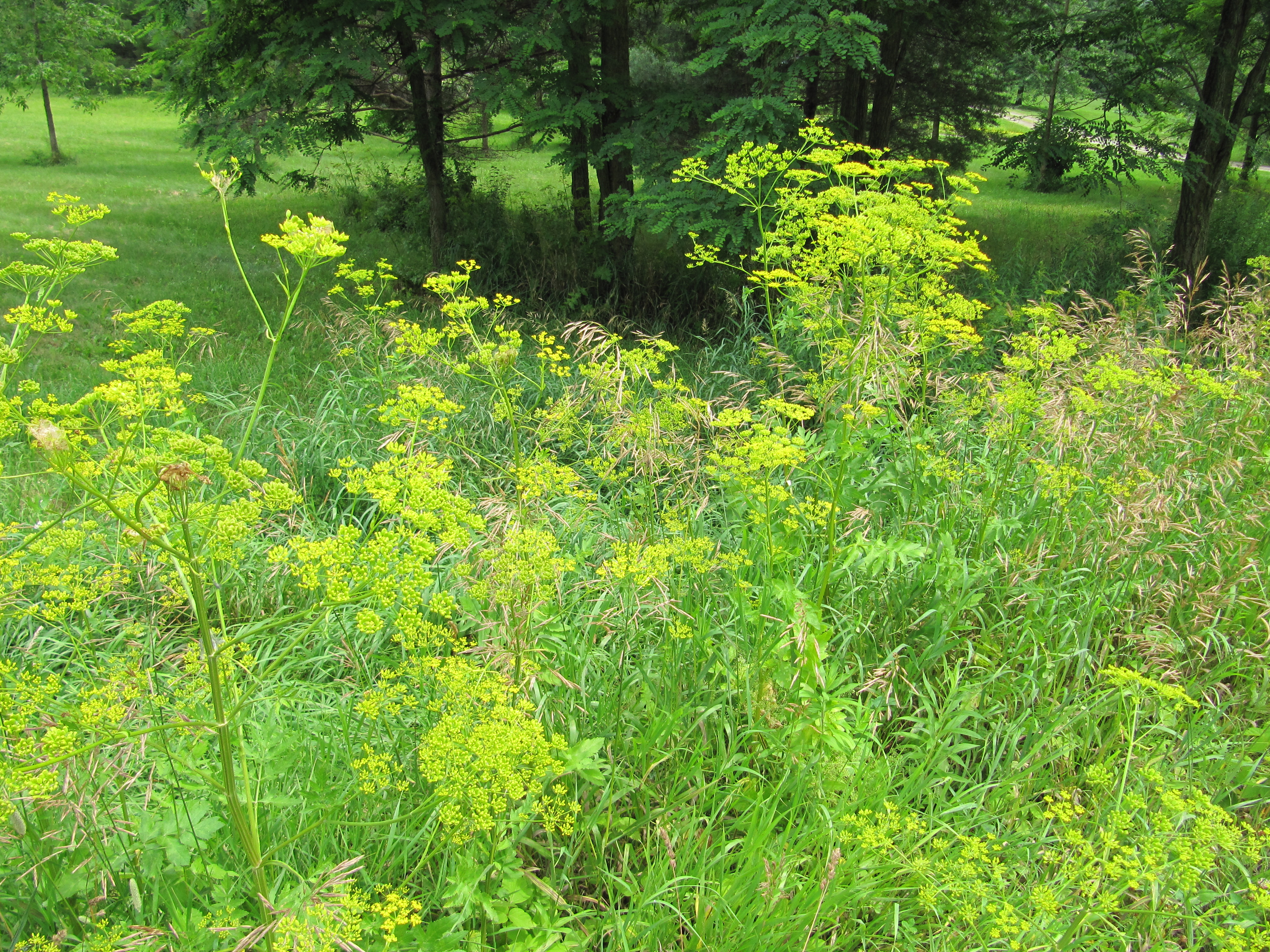
I wrote about the wild parsnip growing at our place a few days ago. I have certainly been aware of it all along but since then I have been hyper aware, even more than I had been. And let me tell you, that stuff is everywhere. Any open field that hasn’t been cut recently is just covered. It is so tall that it drowns out everything else. When I look out over a field that has been taken over, I can’t see much of anything else–no grass, no flowers, no milkweed, no nothin’.

I drove today on the back roads from Hinesburg to Charlotte (which means, well, almost any road from Hinesburg to Charlotte) and there was a clear distinction between hayed fields and those that have been let lie. I saw a couple of fields where large patches had been left uncut. There was a rock or a wet area or some other obstruction to the mower. These were deep in wild parsnip. I mean, invasive species can be pretty aggressive. This one hits home for me. I mean, it really does hit home.

The problem is that the fields become a danger zone. Forget poison ivy. This is worse. Sure ticks are out there, but they are not nearly as likely to be an issue as wild parsnip. I am afraid to send my children out in the field because I do not want them to have chemical burns. Ouch. It is just a plant for chimney’s sake, but it is a ubiquitous and menacing plant.

This stuff has been around for many years, maybe even for over 400 years. It may have been brought here on purpose, as a food source, but no one really knows how it came to North America from Eurasia. It has certainly made itself at home, however. I see tons of it all over the place and, frankly, it creeps me out. Aside from the fact that I am in awe of how any species can be so adaptable and can just make it over other species, I am in awe of its bully-ness and unhappy about it. I guess I need to do what I can to control it in our part of the world and hope conditions for it deteriorate at some point so its presence lessens in the future.

For more good information about this plant you can check out the Eastern Forest Environmental Threat Assessment Center’s page, or the US Forest Services “Weed of the Week” page on it.

Wild Parsnip

Wild Parsnip

Up Close

I first noticed it in 2006, a tall yellow flower growing in the field. It was just one of several other plants, including Queen Anne’s lace, a couple varieties of goldenrod, and all those grasses I can’t identify. I looked it up. It wasn’t easy to find in the Vermont flower guide but I did find it in the edible wild plant guide. And I thought: Wild parsnip, huh? Interesting. Edible roots, related to carrots and cultivated parsnip. Worth trying one of these days?

But this plant has a nasty side. Rub up against it and get its oils on your skin, then hang out in the sun and watch out. Sunlight brings on burns and blistering because the plant goo is photoreactive. The result is ugly and painful. Not a plant to mess with, especially in summer. Unfortunately, that is when it grows. And grows.

Last summer the stuff took off. Road crews mowed less, so it grew more than usual, and it just had a banner year. This summer it has taken over roadsides and fields pretty much anywhere that isn’t cut. It grows tall, too–taller than me. Over six feet sometimes. There used to be a mix of plants, but where this grows it seems to dominate. Queen Anne’s lace just can’t compete. Late in summer its seeds will spread all over and it will grow even more next year.

That is one reason we want to cut our own field more often–to get rid of this plant. We can’t let it go to seed, that is for sure. The field was cut last month and it still is coming back, stretching its yellow flowers above everything else that is growing. We need to cut again soon to repel it once more.

So, yes, apparently, one can eat the roots–boil them up and have oneself a meal. It would feed many people, the way it grows around here. It isn’t native but it sure has made itself at home. I like to be welcoming, but I wouldn’t miss this plant if it decided to take up and move away. At least purple loosestrife has beautiful flowers and doesn’t cause wounds (except when I try to pull it up by the roots with bare hands). Wild parsnip is a fine plant, I am sure, once you get to know it. If it were not so aggressive I might even appreciate it. This bully, however, needs to keep it in check and learn to play nice.

Unfortunately, as the world of flora goes, I don’t see that happening.

Meadowlark

Blurry but an Eastern Meadowlark Nonetheless

When we moved off the mountain to our home in the valley a few years ago, it gave me a chance to learn some new birds. I knew most of the birds I saw and heard when we lived a couple thousand feet higher, but those birds do not live down here. I learned the bobolink, flitting about the fields, and was happy to know they were fairly abundant. I learned the song sparrow. I got to know the barn swallow. This year I heard a song I had been missing, either because it was not there, or because I simply wasn’t paying attention. I thought it was a meadowlark.

So I looked it up with the power of the internets. Sure enough, at the Cornell Lab of Ornithology and its All About Birds web site, I checked the song I was hearing with a recorded one. Eastern Meadowlark is what we had. I kept looking for them and not seeing them. I would hear the yellowish rascal but not see it craftily hiding in the tall grass. See See SEE-yeer. I saw one today, however.

I sat drinking my foamy coffee drink, eating raspberries and peaches with yogurt and granola, when I heard the call. I mean, I literally heard the call, of the meadowlark. So I scanned the field with binos and eventually saw the little dude poking his head up and singing. It kept popping up and down in the grass but I got a good enough look to get a visual confirmation of the species.

Meadowlarks are ground nesters, so now we have a dilemma. We plan to cut the field more than once this summer but I would hate to destroy a nest. They take around 4 weeks from laying eggs to the young flying solo, so I guess as long as we give over a month between cuttings we might save a nest or two. Or maybe not, depending on the timing of things. First bobolinks and now meadowlarks. These field nesting birds make for some mental figure eights. We want to cut the field to provide, eventually, hay for local cows. We also want to cut it to reduce the amount of wild parsnip we have. That plant pretty much takes over and is a nasty invasive that can cause terrible skin burns, so we want it gone from here if we can help it. But the birds…

I do not want to drive away the meadowlarks (or bobolinks or song sparrows) but I do want to cut the field. We will have to monitor the birds to see that we do as little damage as possible. It is good to know that these birds are definitely here. I would hate to push them out just as I am getting to know them.

End of the Day

Warm night. Lightning bugs dot the field. Children sleep their innocent sleep, half under blankets.

Summer has arrived. I watched the sun set on the lake tonight. The Adirondacks outlined in pink and red. Peepers still sing to one another in the darkness.

I am in love with everything around me–my wife, my children, this world. I am love with the lightning bugs and the sunset. My heart leaps up.

Dew settles as the air cools. The wind has the night off. The sun wakes the other side of the earth. Somewhere outside the house, a skunk searches for breakfast.

How can I sleep with such wonder? How can I sleep with such beauty? And what about love? That, too, keeps me stirring long after my family sleeps, long after I have risen and left my bed to gather the day’s dust.

Finding Birds in the Wee Hours

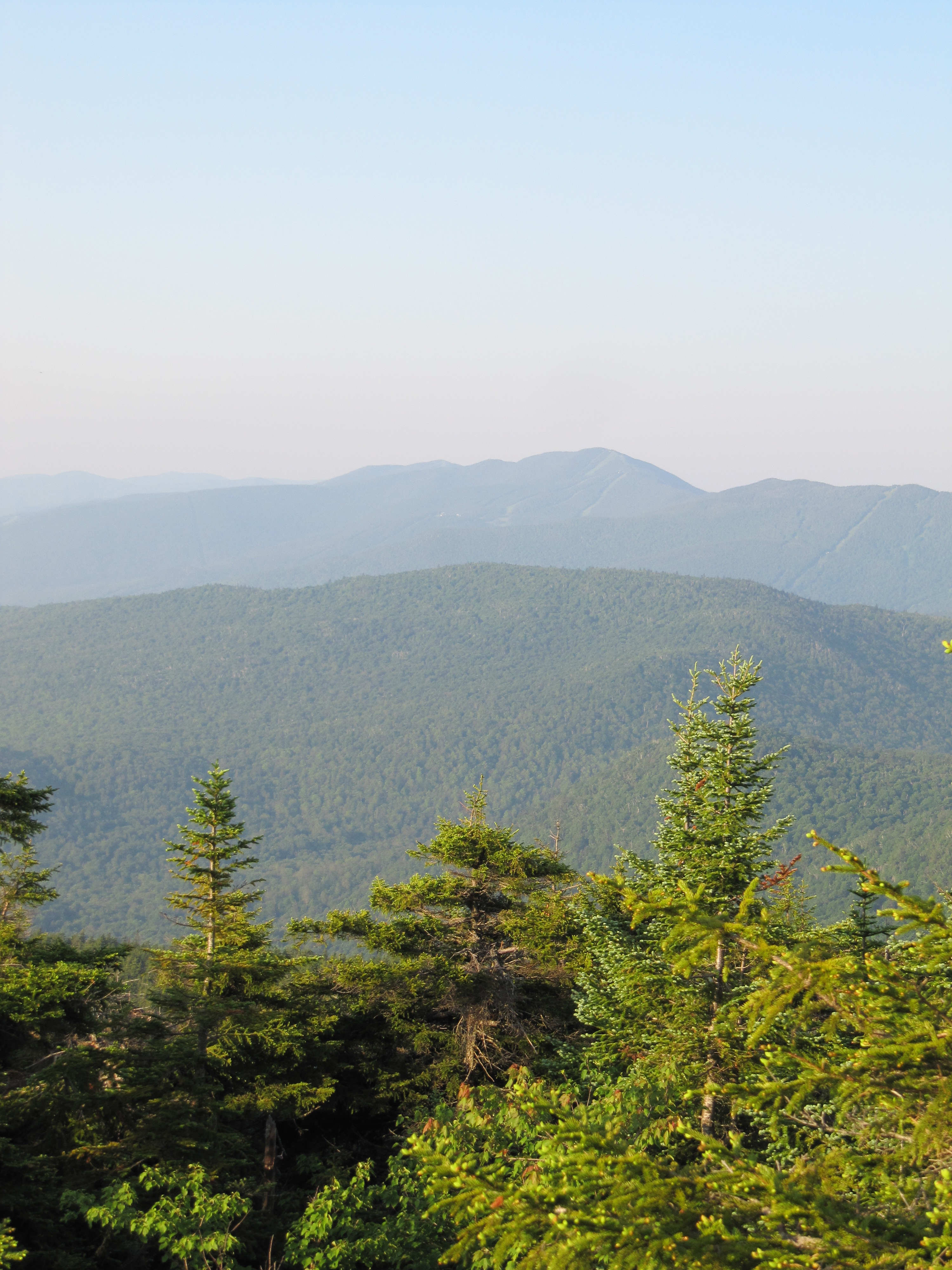
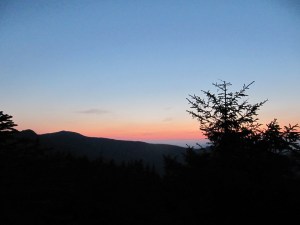
Before Sunrise from Burnt Rock Mountain

For the second time this week, I got up early, drove, hiked uphill for a ways and then sat in hopes of finding some birds. Last year I had volunteered to do a second survey for Mountain Birdwatch, sponsored by the Vermont Center for Ecostudies. I agreed to do it again this year. I packed up the night before, and readied the espresso maker, so all I had to do was rise, brush my teeth, quickly brew some java and head out the door with my backpack. Other than trying to stay quiet so I don’t wake everyone else, the biggest challenge is just getting up. I had to set the alarm for 12:45. It was barely today when I turned back the blankets.

I managed to get out quickly, however, hot coffee in a travel mug (Americano, with cream) next to me in the cup holder. I had planned for extra time, although I did not need it, as the forecast was for heavy fog. I passed through some fog but I drove over Appalachian Gap on Route 17, so I was higher than any fog for a good chunk of the time.  I started driving at about 1:00 and started hiking about 2:15. I was, as you might imagine, the only one on the trail.

My headlamp guided me, and I did feel a little tired. I was up at 2:00 on Monday morning (shorter drive for that survey route) and I stayed up way too late to watch a movie one night (Sherlock Holmes–too good to watch halvsies) so I wasn’t as perky as I might have been. I got to the Long Trail in about an hour and 30 minutes later I was on the top of Burnt Rock Mountain.  I had 15 minutes to spare before I could officially start at 4:00, so I donned some warm layers, lay against my backpack on the warm stone, and waited. The wind was gusting pretty strongly but not so much that I would not be able to hear birds songs. The stars were out. Jupiter dangled in the eastern sky like an earring. The horizon just hinted at the day to come.

I could have fallen asleep. I had to make sure I kept my eyes open. At four I pulled out my notebook to get started. But no birds were singing. So I waited. Nothing. Was it the wind? I waited until 4:25 and the first bird I heard was the one I most wanted to hear–Bicknell’s Thrush. At that first survey point I heard three of them.

Here is the thing. Some people get excited where their team gets a home run. Others get excited when they win at horseshoes or craps or softball. Some get fired up by nightlife. I get elated when I hear a Bicknell’s Thrush singing. It lifts me up and smacks a huge smile on my face. These little brown birds face a lot, from habitat loss in both their and summer homes, to distant migrations, to acid rain and climate change, so to hear that they have returned for another summer brings me pure joy.

I head them again at the second and third of five survey points. It was peaceful in the woods. I heard many birds, despite the wind. I heard plenty I was not seeking. In fact, I heard a long list of birds. On my hike overall I heard (I only saw a couple of birds the whole time, flying away from me in terror of my fierceness I suppose) these species:

  • Bicknell’s Thrush
  • Hermit Thrush
  • Swainson’s Thrush
  • Veery
  • Robin
  • Winter Wren
  • White Throated Sparrow
  • Black Capped Chickadee
  • Dark Eyed Junco
  • Brown Creeper
  • Red Breasted Nuthatch
  • Yellow Bellied Flycatcher
  • Golden Crowned Kinglet
  • Blackpol Warbler
  • Yellow Rumped Warbler
  • Magnolia Warbler
  • Black Throated Blue Warbler
  • Black Throated Green Warbler
  • A couple other warblers I couldn’t identify
  • A woodpecker that was drumming but split as I passed
  • Blue Jay

I might have missed a couple here but it was, you might say, a good morning for this citizen scientist. It was a peaceful hike and I enjoyed some time in the woods. And my guess is that I was home before anyone even got to that particular trailhead today. A day’s work, done by breakfast.
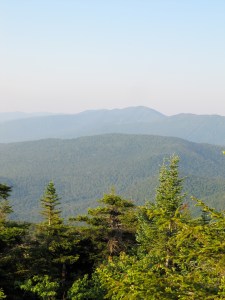
After Sunrise

What Bird is This?

Thanks to Ohio-Nature.com

Yesterday during my early morning bird survey, I heard a bird I have heard many times in that same area.  I have looked it up in the past but still could not remember what bird it might be. I did not see it yesterday, but I remembered it to be yellowish in part, and I could tell it was a warbler. Of course, that hardly narrows it down.  There are almost as many yellowish warblers as there are reasons I don’t want to scrub the toilet. So I had to search. Again.

I took advantage of the birders tool of choice when trying to identify that mystery species:  Google. I just typed in “warbler songs and sounds” and up came several hundred thousand possible sources of just the right information.  Google led me right off to All About Birds, from the Cornell Lab of Ornithology. This is a site I have used before and it is usually right on the money.  It mostly helped, but I had to search around a bit until I was sure I had the right bird.

I had in the back of my mind, a fuzzy memory from years past, that this was a Magnolia Warbler.  The song included on All About Birds was close but not quite what I was hearing.  The song I heard yesterday, and all the other days I have been up there, was consistent.  It did not vary one bird to the next or from year to year.  Two notes, two notes, three notes. One two, one two, one two three.  The songs I kept finding were similar, but not all the same as each other, and not the same as I was hearing.  But then, on a web site I did not mark and do not remember, I heard the song I needed to hear. It was my song.

Sure enough, I was right about Magnolia Warbler.  It was the right habitat, the right range and, now that I had confirmed it, the right song.  Done deal.

About Night

Crickets call. Fireflies twinkle across the field. Children asleep. It is just about dark.

Peonies and roses still let their scents sneak out into the dark air. Fresh cut grass lingers under the dew. Pineapple plants and dirt.

A small breeze. Peepers singing in the pond and the ditch. The air cools. A few cars hush past. The solstice prepares its visit.

In winter it would have been dark for hours by now. The green world grays. Later, the moon will rise. Quiet.

Quiet.

Snapper

Laying Eggs

This snapping turtle was laying eggs a few days ago. Good for you, turtle. Procreate! I’m all for those cute little buggers popping out of the sand and wiggling their way toward a new life trying to avoid things like raccoons and crows, who only want to eat them for breakfast.  This turtle, however, was depositing its potential offspring right on the side of the road.  Cars are whizzing by and its just hanging out there, popping out unformed youngsters.

Honestly, I’m not sure why turtles have been around for millions of years, or why they live to be, like, 100. Granted, we have pretty much destroyed any hope of any other creatures, aside from the ones we eat, surviving at all on this mess of a planet, but come on, turtle, how about my driveway at least? Those speeding high schoolers won’t slow down for you if they don’t slow down for the rain soaked muddy turn. That most humans don’t live to be 100 makes sense to me.

I’ll have to watch out for those little guys in however long it takes for snapping turtle eggs to hatch. I’ll even move them to safer locales, too, as long as it isn’t when school gets out.